
Tesla · EV tariffs · Great Britain
How to charge a Tesla as cheaply as possible in the UK
Cheap home charging is not one trick. First, the tariff has to reward flexibility. Then the charging plan has to use the right periods without compromising the battery target or departure time.
A parked Tesla gives you something most household appliances do not: time. If the car is plugged in from 18:00 until 07:00 but only needs around three and a half hours of charging, you have a wide window in which to choose when those kilowatt-hours arrive.
1. There are two separate savings decisions
The biggest mistake is to treat every EV tariff as if it needs the same optimisation. In practice, there are two layers.
| Layer | Question | What can save money? |
|---|---|---|
| Choose the tariff | What does your home electricity contract charge for EV energy? | A lower off-peak or flexible rate can reduce the baseline cost dramatically. |
| Schedule the charge | Does the price still vary inside the time when the car is parked? | If yes, choose the cheapest suitable periods before departure. |
If your tariff offers four or five hours at one fixed cheap rate, Tesla's own schedule may already do most of the useful work. If your rate changes every half-hour, a fixed 01:00 start time leaves money on the table whenever tomorrow's cheap periods move.
2. Start with the tariff type, not with the clock
| Tariff type | How the price behaves | Best charging approach |
|---|---|---|
| Single-rate / default | Same unit rate throughout the day | Timing has little direct energy-price value. |
| Fixed off-peak EV tariff | Cheaper price in a known time window | Fit the required charge inside that window. |
| Supplier-managed smart EV tariff | The supplier schedules or rewards flexible charging | Check what optimisation the supplier already performs. |
| Half-hourly dynamic tariff | Import price can change every 30 minutes | Choose the cheapest valid half-hours each day. |
Ofgem's price cap is a useful benchmark for a default tariff, not a target EV charging rate. From 1 July to 30 September 2026, the average capped electricity unit rate for a Direct Debit customer in England, Scotland and Wales is 26.11p/kWh, with an average standing charge of 57.19p/day. Actual capped rates vary by region.
A specialist EV tariff can be cheaper for the car, but the whole household contract still matters. A very low overnight rate can be offset by a higher peak rate, a different standing charge or poor fit with the rest of the home's consumption.
3. What a real charging window looks like
Take a simple example. The Tesla arrives home at 18:00, needs 38 kWh, can charge at 11 kW and must be ready at 07:00. Ignoring losses for the moment, the car needs roughly 3.5 hours of charging. The plug-in window is 13 hours.
On a half-hourly tariff, that 13-hour window contains 26 price periods. The car does not need all 26. It only needs enough of them to deliver the required energy — plus a practical margin for charging losses, changing charge power and the battery taper near a high target.
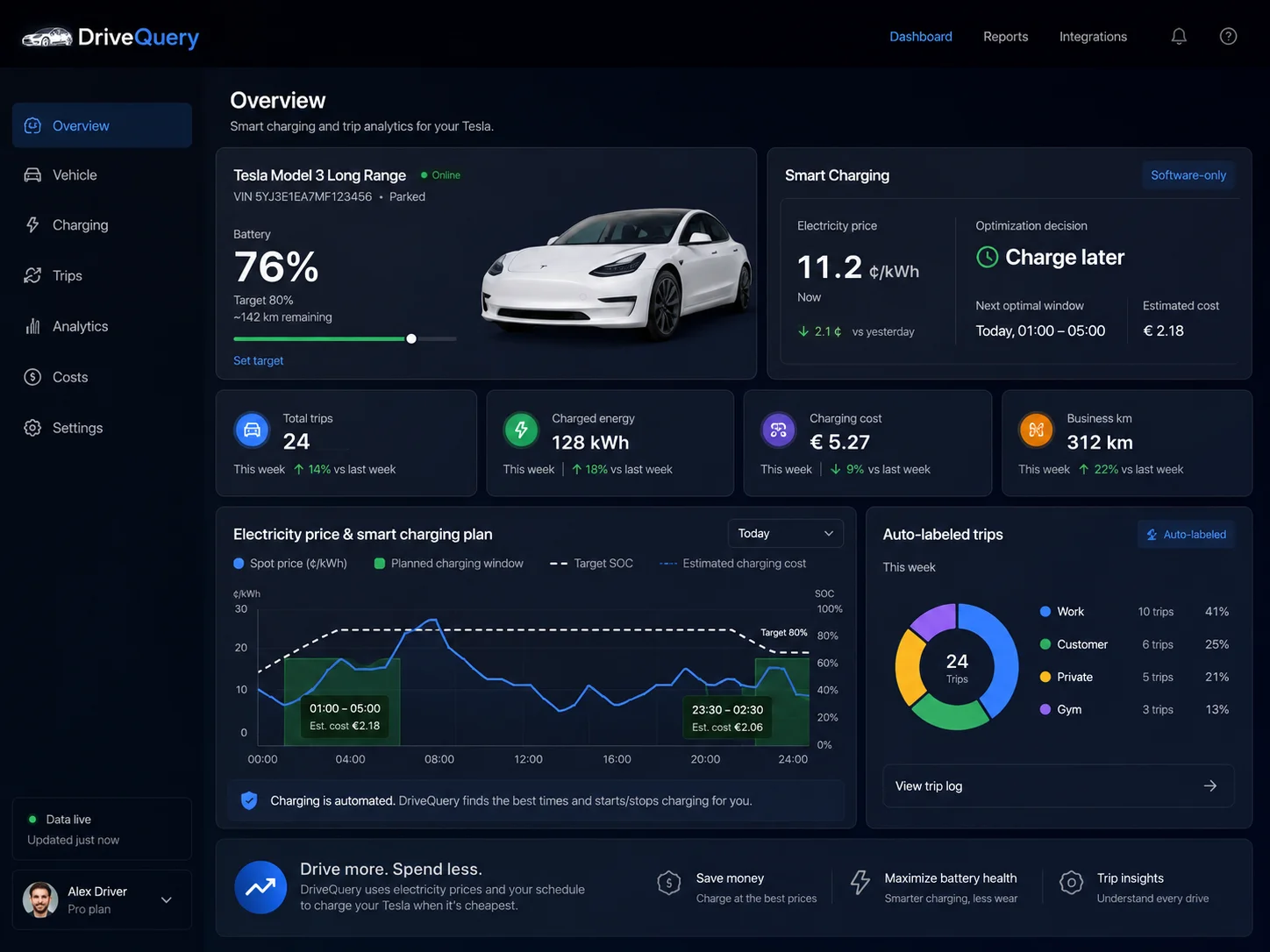
The graph is deliberately illustrative. The point is not that 23:00 is always cheap. The point is that a dynamic plan can use whatever periods are cheapest that day, as long as the car still reaches the requested state of charge on time.
4. Fixed EV window and dynamic tariff: the optimisation job is different
A fixed cheap EV window is simple. If your tariff says the car gets a low rate from, say, the middle of the night until early morning, the goal is to fit charging inside that window. There is no extra benefit from choosing one half-hour over another if both cost exactly the same.
A dynamic tariff creates a different problem. Smart meters can support half-hourly consumption data, which enables tariffs that reward shifting demand away from expensive periods. Government smart-charging policy explicitly describes this as a core benefit of flexible EV charging.
Great Britain's market-wide half-hourly settlement transition is also still underway. Elexon says meter migration began in October 2025, expects around 80% of meters to be under the new arrangements by October 2026 and plans full implementation in May 2027. That matters for the market, but it does not mean every household must be on a half-hourly dynamic retail tariff.
5. What can the cost difference look like?
For a simple annual comparison, assume the Tesla takes 2,000 kWh per year from the home charger. This is not a promise of savings — just a way to see the sensitivity to the effective charging rate.
| Effective EV charging rate | 2,000 kWh/year | Difference vs. 26p/kWh |
|---|---|---|
| 26p/kWh | £520 | Baseline |
| 18p/kWh | £360 | £160/year |
| 12p/kWh | £240 | £280/year |
| 8p/kWh | £160 | £360/year |
The largest saving may come from moving from an unsuitable single-rate tariff to an EV-friendly tariff. Daily optimisation is the second layer. If the cheap rate is already flat, there may be little left to optimise. If prices keep moving, the schedule can still matter every day.
GB calculator
Use your own mileage and tariff rates.
Compare a standard tariff, a fixed cheap EV rate and a flexible-price scenario in pounds per year.
6. Price-aware charging still needs practical guardrails
| Constraint | Why it matters |
|---|---|
| Departure deadline | The car must be ready when you need it, even if the absolute cheapest period comes later. |
| Target state of charge | The plan should optimise only after the required energy is known. |
| Available charging power | A 7 kW charger needs a longer cheap window than an 11 kW charger for the same energy. |
| Charging losses | Energy drawn from the wall is higher than the energy stored in the battery. |
| Manual charging | If the driver deliberately starts charging now, automation should not fight that decision. |
| Tariff ownership | If the supplier already manages charging, a second optimiser must avoid double-counting the same benefit. |
7. Why flexible charging matters beyond the bill
EV charging is a large load that can often wait. The UK Government's smart charging action plan notes that most home-charged EVs are parked for long enough to move charging away from high-demand periods while still being ready for the driver. Shifting charging can reduce system pressure and make better use of periods with abundant renewable generation.
That does not mean the lowest retail price always equals the lowest-carbon half-hour, and it does not mean every customer should chase wholesale prices. It does mean that a parked EV is unusually well suited to flexible demand.
8. Where DriveQuery fits
For the automation itself, see Tesla charging schedule and smart charging. For the deeper dynamic-price logic, see Tesla dynamic tariff charging.
The product principle is simple: the driver sets the outcome; the charging logic deals with the tariff.
| If your tariff is… | A sensible DriveQuery strategy is… |
|---|---|
| Fixed off-peak | Fit the required energy inside the cheap window and stop when the target is reached. |
| Half-hourly dynamic | Rank the valid half-hours by the price the customer actually pays and select enough to meet the target. |
| Supplier-managed smart EV tariff | Recognise that the supplier may already control the charging schedule and avoid competing automation. |
| Single-rate | There is little direct energy-price value in moving the charge, so convenience and other constraints dominate. |
The instruction to the system should stay human: “80% by 07:00.” The tariff mechanics belong underneath that requirement.
Frequently asked questions
Is night-time always the cheapest time to charge a Tesla in the UK?
No. A fixed EV tariff may have a guaranteed cheap overnight window, while a dynamic tariff can move its cheapest half-hours from one day to the next.
Do I need a smart meter for a half-hourly EV tariff?
Usually yes. Half-hourly smart tariffs generally need compatible smart-meter readings so the supplier can price consumption by time period.
Is an EV tariff always cheaper than a standard tariff?
No. The EV rate can be attractive while peak rates, standing charges or the rest of the household's usage make another tariff cheaper overall. Compare the complete contract.
Does a fixed off-peak tariff need daily price optimisation?
Not necessarily. If every half-hour in the cheap window costs the same, the main job is simply to fit the required charging inside that window before departure.
Can a dynamic tariff become expensive?
Yes. Dynamic prices can rise as well as fall. A charging plan can avoid expensive periods when enough flexibility exists, but it cannot guarantee a particular saving.
Is market-wide half-hourly settlement already complete in Great Britain?
No. The transition is underway. Elexon says migration continues through 2026 and full implementation is planned for May 2027.
Sources and UK market information
- Ofgem: Energy price cap unit rates and standing charges
- Ofgem: Economy 7 tariff guidance
- Ofgem: Smart meters and half-hourly data
- Elexon: Market-wide Half-Hourly Settlement
- GOV.UK: Electric vehicle smart charging action plan
Make the tariff work around the car.
Join the waitlist and follow the development of DriveQuery smart charging for Great Britain.