
Tesla charging · United Kingdom
Tesla charging in the UK: home, Supercharger, cost and charging time
Charging a Tesla can be simple: plug in at home, use a Supercharger on longer journeys, or charge at a compatible public point. The real questions are where to charge, how long it will take, what each kWh costs and whether the car will be ready when you need it.
The main ways to charge
How do you charge a Tesla?
Most Tesla drivers use a mix of home charging and faster public charging. The right option depends on where the car is parked, how much energy it needs and how soon it has to be back on the road.
Charge at home
Plug in where the car normally spends the night. Home charging gives you the most control over timing and electricity tariff.
Tesla Supercharger
Find a Tesla Supercharger near you on the UK map →
High-power DC charging designed for road trips and quicker top-ups. Tesla route planning can include Supercharger stops automatically.
Public charging
Compatible third-party AC and DC chargers extend the network beyond Tesla sites. Access, price and charging speed depend on the operator.
Charge by price
At home, the time of day can matter as much as the amount of energy used. Off-peak and dynamic tariffs can create cheaper charging windows.
Tesla home charging: the everyday option for many UK drivers
If you can park near your home and install suitable charging equipment, home charging is usually the easiest way to keep a Tesla ready for daily use. Tesla describes home charging as a convenient way to plug in where you park and make use of lower overnight electricity pricing.
A dedicated home charger gives you a repeatable routine: arrive, plug in and let the car recharge while it is parked. Tesla's own Wall Connector is one option, but Tesla vehicles can also use other compatible charging equipment.
Convenience
Charging happens while the car is already parked, so there is no separate refuelling stop in normal daily use.
Control
You can choose when charging starts and combine the schedule with your electricity tariff and required departure time.
Cost visibility
Home charging makes it easier to connect kWh used with the actual electricity rate you pay.
For a deeper look at home charging, see the full UK guide. It covers dedicated chargers, 3-pin charging, charging power, installation, overnight tariffs and home charging cost in more detail.
Fast charging on the road
Tesla Supercharger: fast charging for longer journeys
Superchargers are Tesla's high-speed charging network. You can navigate to a Supercharger from the car, and Tesla can precondition the battery before arrival to help prepare it for faster charging.
Tesla currently states that UK Superchargers can provide up to 250 kW and add up to 172 miles of range in 15 minutes in suitable conditions. Those figures are not a promise for every session: actual charging speed depends on the vehicle, battery temperature, battery state of charge and site conditions.
Charging also slows as the battery fills. That is why a shorter top-up can be more time-efficient on a journey than waiting for a very high state of charge when the route does not require it.
Charging a Tesla at public chargers
A Tesla is not limited to Superchargers. Compatible public AC and DC charging networks can be useful near shops, workplaces, hotels, destinations and routes where another operator is more convenient.
The important difference is that public charging is not one single tariff or experience. The operator decides the price structure, how a session is started, whether an app or card is needed and whether additional parking or overstay fees apply.
For cost comparisons, treat public charging separately from home charging. A home electricity rate, a motorway rapid-charging price and a destination charger can all produce very different £/kWh figures even if the same amount of energy reaches the car.
£ per kWh matters
How much does it cost to charge a Tesla?
The basic calculation is simple:
What makes the real answer more interesting is where those kWh come from. At home, the relevant price is your electricity tariff during the charging period. At a Supercharger or third-party public charger, the charging operator's rate applies.
For home charging, a useful estimate should also consider how much energy the car actually needs over a month or year rather than assuming every session is a full battery charge. Driving distance, Wh/mile consumption and charging losses give a more realistic picture.
Home
Your tariff and charging time are the main controllable inputs. Off-peak pricing can materially change annual charging cost.
Supercharger
Prices are location-specific and can change. Tesla shows current Supercharger information in its own interfaces.
Public networks
Rates, subscriptions and extra fees vary between operators, so compare the complete session cost rather than one headline rate.
Charging rates for Tesla: price and speed are different
If you are comparing charging rates for Tesla, check the unit first. p/kWh is a price and belongs in a cost comparison. kW is charging power and belongs in a charging-time comparison. Use the Tesla charging cost calculator for price rates, or jump to Tesla charging time for power and speed.
For a month-by-month view, see Tesla charging cost per month. To attribute a price to individual sessions, use the Tesla charging cost tracker.
Tesla charging time: how long does charging take?
Tesla charging time depends on the charging method, available power, vehicle, battery temperature and how many kWh you actually need to add. A useful estimate starts with the energy required before the next departure rather than assuming every session runs from 0% to 100%.
| Charging method | Typical / available power | 20 kWh top-up | 35 kWh top-up | Best suited to |
|---|---|---|---|---|
| UK domestic socket | about 2.3 kW | ~8 h 40 min | ~15 h 15 min | Occasional, slower charging |
| Dedicated home charger | about 7 kW | ~2 h 50 min | ~5 h | Regular overnight charging |
| Three-phase AC | up to 11 kW vehicle-side where available | ~1 h 50 min | ~3 h 10 min | Homes or destinations with suitable three-phase supply |
| Tesla Supercharger | Rapid DC; V3 sites up to 250 kW | Charging power is not constant, so simple energy ÷ peak power is not a reliable session-time estimate. | Fast top-ups on longer journeys | |
The AC examples are simple energy ÷ power estimates before charging losses and power variation. Real charging time can be longer. Tesla publishes model-specific Supercharging performance because DC charging speed changes during the session.
Home charging time
At home, charging is usually planned around the hours the car is parked. A dedicated charger can often add the energy used during the day within an overnight window. See the Tesla home charging guide for 3-pin, 7 kW and 11 kW examples.
Supercharger charging time
Supercharging is designed for shorter stops. Tesla's UK support currently gives model-specific figures for miles added in 15 minutes, while actual power depends on the vehicle, battery temperature and state of charge.
For planning, think in terms of energy required before departure, not “time from 0 to 100%”. If you arrive home with enough battery for tomorrow and only need a modest top-up, the required charging window may be much shorter than a full-battery estimate suggests.
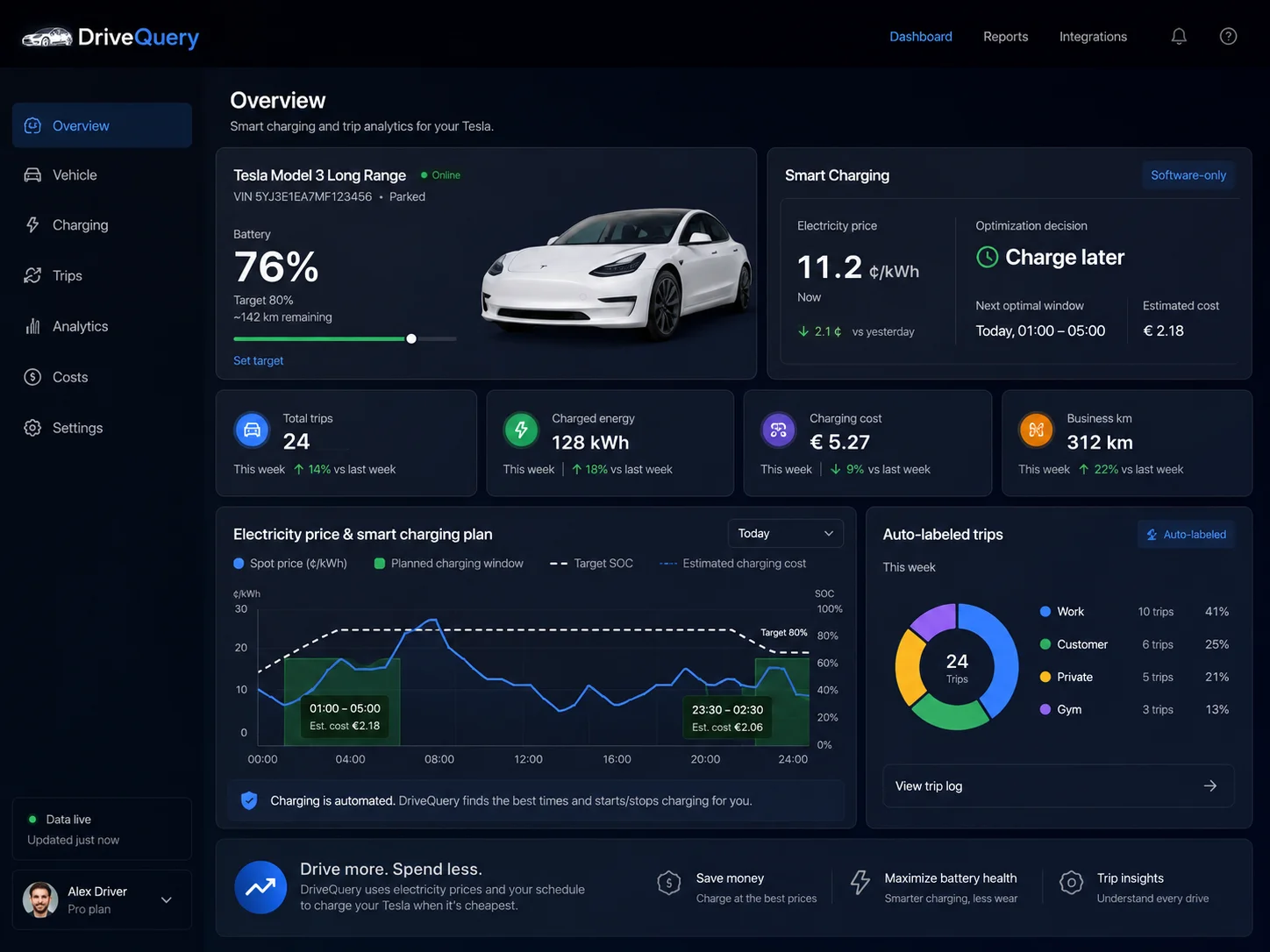
Price + deadline
Charge a Tesla at cheaper times without missing the departure target
With a simple off-peak tariff, charging inside a fixed cheap window may be enough. With dynamic pricing, the cheapest period can move from day to day, which makes a fixed schedule less useful.
A good charging plan needs to combine:
- current battery level – how much energy is missing?
- target charge – what state of charge do you actually need?
- departure time – when must the car be ready?
- electricity price – which available charging intervals are cheapest?
The objective is not to chase the single cheapest half-hour. It is to select enough lower-cost intervals to reach the required target on time.
Guide: charge your Tesla at the cheapest hours →
Tesla dynamic tariff charging app →
How DriveQuery smart charging works →
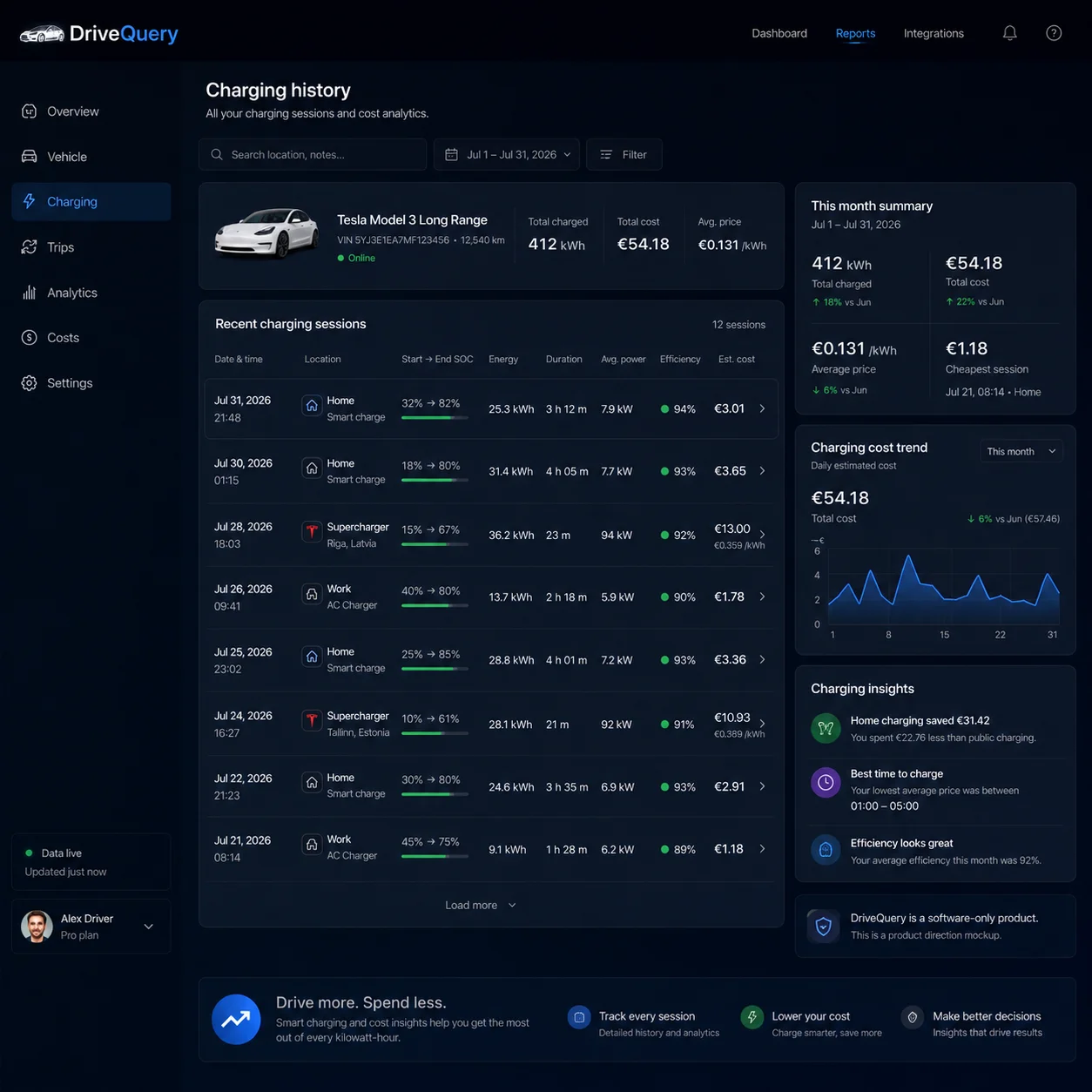
Tesla charging history: see what happened after you unplug
Charging is easier to optimise when it leaves a useful record. Tesla's Charge Stats can help supported owners understand charging behaviour and estimated spending. DriveQuery is designed to connect charging sessions with location, energy, cost and the trips around them.
Charging history
See when and where charging happened and how much energy was added.
Cost tracking
Attach tariff information to individual sessions instead of relying only on the electricity bill total.
Export
Turn charging records into CSV or PDF data for analysis, reimbursement or documentation.
Frequently asked questions about Tesla charging
How do you charge a Tesla in the UK?
You can charge at home with suitable charging equipment, at Tesla Superchargers, or at compatible public AC and DC charging points.
Can you charge a Tesla at home?
Yes. Home charging is usually the most convenient everyday option when you have suitable parking and an appropriate electrical installation.
How much does it cost to charge a Tesla?
Multiply the energy added in kWh by the price paid per kWh. Your home tariff or public charging rate determines the cost.
What is the typical Tesla charging time?
It depends on charging power, vehicle capability, battery temperature, state of charge and how many kWh need to be added.
How fast can a Tesla Supercharge?
Tesla currently states up to 250 kW and up to 172 miles added in 15 minutes in suitable conditions. Real-world speed varies by vehicle and battery conditions.
What is the cheapest way to charge a Tesla?
For many drivers, home charging with a suitable off-peak or dynamic tariff gives the most control. The charging schedule still needs to reach the required battery target before departure.
Where can I see Tesla charging history?
Tesla offers Charge Stats for supported vehicles and accounts. DriveQuery adds a longer-term session history with cost, location and export workflows.
Do I need a Tesla Wall Connector?
No. It is Tesla's dedicated home charging product, but compatible alternatives can also charge a Tesla.
Sources and last reviewed
Last reviewed: 15 August 2026. Tesla-specific charging information was checked against Tesla's current UK charging and support pages.
See charging clearly. Then make the timing smarter.
DriveQuery connects Tesla charging history, trips and electricity prices so charging decisions need less manual work.