Current Tesla mileage
The odometer is the vehicle's accumulated mileage. Use the Tesla app or touchscreen when you only need the current total.

Tesla mileage UK
See your Tesla mileage in context: current odometer, journey-by-journey mileage history and business-versus-private miles for UK records and HMRC review.
Available now · no sign-in
Use the free manual tool now. Enter start and destination addresses, let DriveQuery calculate the road miles and download a proper PDF or Excel report.
Tesla mileage explained
Your Tesla's current mileage is its odometer reading. Tesla says you can find the odometer in the Tesla app by scrolling to the bottom of the vehicle's main screen, or on the touchscreen under Controls → Software or Controls → Trips.
That current number answers how many miles are on the car? A mileage history answers a different question: which journeys created those miles? For business use, the useful record goes one step further and attaches the confirmed purpose of each journey.
The odometer is the vehicle's accumulated mileage. Use the Tesla app or touchscreen when you only need the current total.
A journey history adds dates, distances, routes and stops, making it possible to understand how the odometer increased over time.
For UK expense and tax records, the key figure is qualifying business mileage — not the vehicle's total odometer reading.
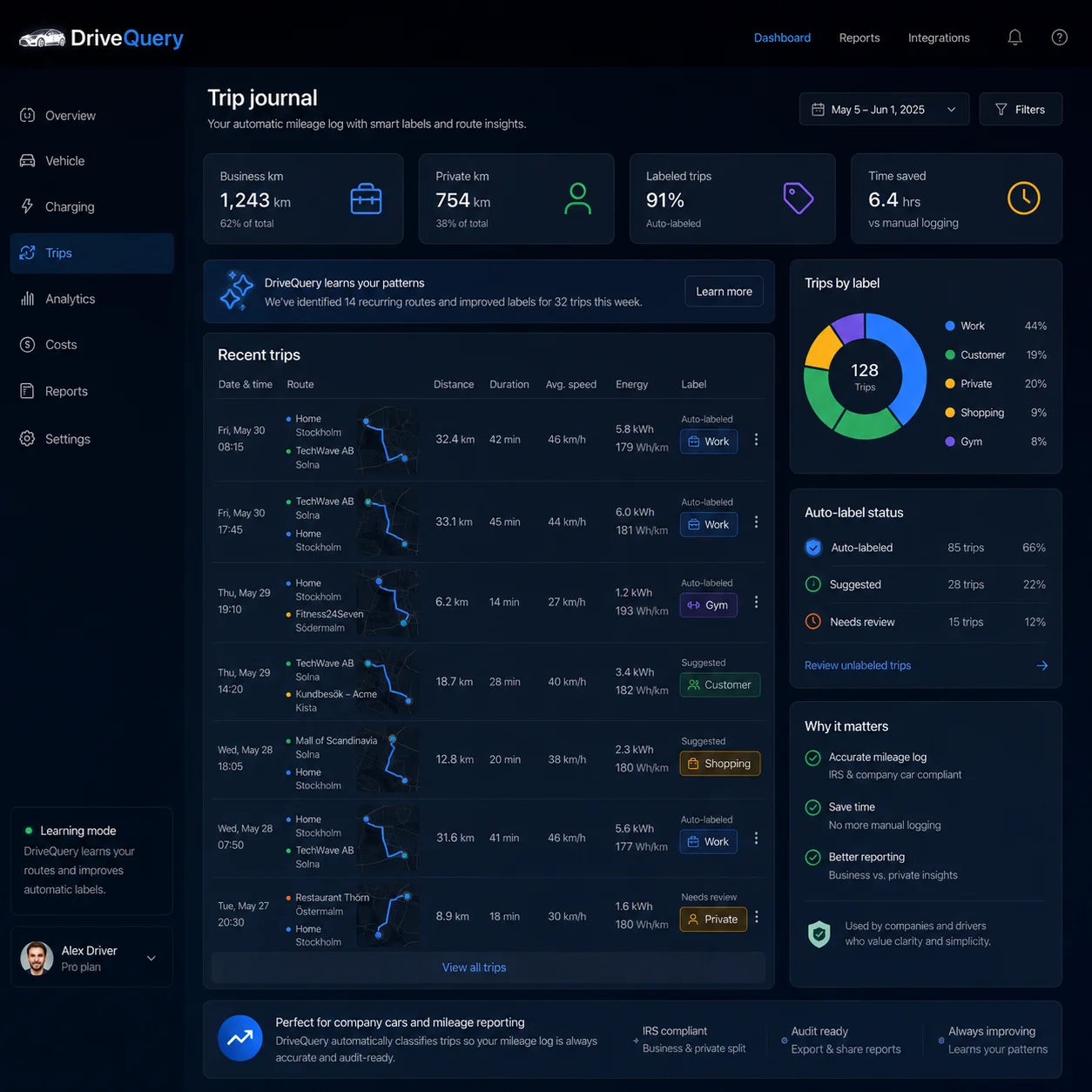
DriveQuery is designed to turn available Tesla trip data into a reviewable mileage record, with recurring journeys suggested as business, commuting or private.
See how Tesla trip history and journey mileage fit together →
Source: Tesla UK – Tesla App Support.
DriveQuery is designed to collect available journey data through the Tesla connection as you drive. The missing part is the reason for the journey. It can then suggest whether a familiar journey is business, commuting or private, leaving you to confirm the purpose when it matters.
For the 2026/27 tax year, HMRC’s approved mileage rate for an employee using their own car or van is 55p per business mile for the first 10,000 business miles and 25p per mile after that. Electric cars are included. The difficult part is not the multiplication — it is maintaining a reliable record of which journeys were actually business travel.
A normal journey between home and a permanent workplace is ordinary commuting and does not qualify as business mileage. Travel to a customer, between workplaces or to a genuine temporary workplace can be treated differently. A useful mileage log therefore needs more than a Business or Private switch: it needs enough context to explain why the journey was classified that way.
If an employer pays less than HMRC’s approved amount for eligible business mileage in an employee’s own car, the employee may be able to claim Mileage Allowance Relief on the shortfall. A clean mileage record is the starting point for calculating the approved amount and comparing it with what the employer actually paid.
The 55p approved mileage rate is for an employee’s own vehicle, not a company Tesla. Company-car reimbursement follows different rules, but the employer or employee may still need to know exactly which journeys were business travel and which were private or ordinary commuting.
Self-employed drivers using simplified vehicle expenses can use the same 55p rate for the first 10,000 business miles in 2026/27 and 25p after that. HMRC expects records of business miles, so automatic capture is especially useful when the same Tesla is used for both work and personal driving.
A car can recognise a repeated route, but it cannot know with certainty whether today’s visit was a customer meeting, a private errand or a commute. DriveQuery is therefore designed to learn from confirmed journeys, suggest the likely category and surface uncertain trips for review.
Looking for the software workflow? See the Tesla mileage tracker for business →
Mileage records in the UK
UK tax rules create several situations where the number and purpose of business miles directly affect reimbursements, tax relief or evidence kept by an employer. A useful Tesla mileage log should make those journeys easy to separate from ordinary commuting and private travel.
For 2026/27, HMRC’s approved rate is 55p per business mile for the first 10,000 miles and 25p thereafter. Electric cars are included in the car-and-van rate.
HMRC mileage allowance 2026/27 →If an employer pays less than the approved amount for eligible business travel in an employee’s own car, the employee may be able to claim tax relief on the difference. The calculation starts with accurate business miles.
How Mileage Allowance Relief works →Home to a permanent workplace is normally ordinary commuting and private travel. Customer visits and genuine temporary workplaces may qualify differently, so the route alone is not enough — the purpose matters.
A company car follows different reimbursement rules from an employee-owned car. From 1 June 2026 HMRC's Advisory Electric Rates are 7p/mile for home charging and 15p/mile for public charging, so accurate business miles matter.
Company Tesla mileage & AER →If an employer relies on the business-only exception to the company-car benefit charge, private use must be prohibited and must not actually occur. Ordinary commuting normally counts as private use.
Company car private-use rules →A company Tesla available for private use can create a taxable Benefit in Kind. Zero-emission BIK is 4% in 2026/27 and rises in later tax years.
Company car tax & BIK →Own-car AMAP, company-car BIK and Advisory Electric Rates are different systems. Compare the practical tax and record-keeping differences before choosing a route.
Compare own vs company Tesla →Self-employed drivers using simplified vehicle expenses can claim 55p per business mile for the first 10,000 miles in 2026/27 and 25p after that. HMRC expects records of the business mileage being claimed.
Sole trader mileage log →Travel to a temporary workplace can qualify as business travel where ordinary commuting does not. HMRC's 24-month and 40% rules can change that treatment, so workplace context matters.
Temporary workplace & 24-month rule →Enter your qualifying business miles and employer mileage rate to calculate the 2026/27 approved amount and the potential Mileage Allowance Relief basis.
Open the mileage allowance calculator →The number to watch in 2026/27
HMRC Approved Mileage Allowance
The first 10,000 eligible business miles in a car or van use the 55p rate. Business miles above 10,000 use 25p. The threshold is based on business mileage, not the car’s total annual mileage.
Example
8,240 × £0.55 = £4,532 approved amount
What the log must solve
DriveQuery can collect available route, time and distance data automatically through the Tesla connection. The driver still confirms the journey purpose when HMRC treatment depends on it.
HMRC guidance for mileage claims focuses on being able to support the business journey. For employee tax-relief claims, HMRC asks for mileage logs showing the reason for each journey and the start and end postcodes. Employers also need records supporting mileage allowance payments. The practical DriveQuery model is therefore to retain the factual trip data and attach the confirmed business purpose to it.
DriveQuery workflow
Label recurring journeys once, let DriveQuery suggest the same category next time and keep new or uncertain routes in a review queue. That turns the end-of-month mileage job into checking exceptions instead of recreating a diary.
Sources: HMRC – Mileage Allowance Payments 2026/27, HMRC – vehicles used for work and mileage logs, HMRC – ordinary commuting and private travel and HMRC – simplified vehicle expenses for the self-employed.
Tesla mileage FAQ
Tesla says the odometer can be viewed in the Tesla app by scrolling to the bottom of the main vehicle screen. It is also available on the touchscreen under Controls → Software or Controls → Trips.
The odometer shows the current total, while a trip or mileage history needs journey-level records. DriveQuery is designed to retain available trip distance, time and route context so mileage can be reviewed over time.
No. HMRC distinguishes qualifying business travel from ordinary commuting and private travel. The journey purpose matters, not just the number of miles driven.
For cars and vans, the approved rate is 55p per business mile for the first 10,000 business miles in the tax year and 25p per mile after that. The same car-and-van rate applies to electric cars.
Join the waitlist and help shape the first version.