
Tesla home charging · United Kingdom
Tesla home charging in the UK: charger, speed and setup
Home charging turns the hours your Tesla is already parked into useful charging time. The important choices are simple: how fast you need to charge, what equipment suits the property, what your electricity costs at the charging time and when the car needs to be ready.
Start with the parking place
How can you charge a Tesla at home?
For most UK homes, the choice is between slow charging from a suitable domestic socket and a dedicated home EV charger. A dedicated charger is the normal everyday solution when the property has off-street parking and installation is practical.
| Home charging option | Typical maximum power | Best for | Main trade-off |
|---|---|---|---|
| Tesla Mobile Connector + UK domestic socket | Up to 2.3 kW | Low daily mileage, backup or occasional charging | Slow for large top-ups |
| Dedicated single-phase home charger | Up to 7.4 kW for current S/3/X/Y on 230 V single phase | Regular overnight home charging | Needs professional installation |
| Three-phase installation where available | Vehicle capability up to 11 kW on 400 V three phase | Properties with suitable three-phase supply | Not typical of every UK home |
Power is not the same as energy. kW tells you how fast the charger can deliver power. kWh tells you how much energy was delivered. Your home charging bill is based on energy, not the charger’s headline kW rating.
Tesla Wall Connector vs a 3-pin plug
Tesla recommends Wall Connector as its dedicated home charging solution. It adds app-connected functions such as charging controls, statistics, access control and remote diagnostics. Tesla also supports charging through Mobile Connector, including from a standard UK Type G socket using the UK adapter.
Dedicated home charger
Best when the Tesla is charged at home most nights. It gives you a fixed cable location, much faster charging than a domestic socket and a cleaner routine for overnight or tariff-based charging.
- Up to 7.4 kW on a suitable 230 V single-phase setup for current Model S, 3, X and Y
- Professional installation
- Can make overnight charging a simple plug-in habit
Domestic socket + Mobile Connector
Tesla's current UK domestic socket adapter is rated up to 2.3 kW. That can be enough when the car only needs a small daily top-up, but a large battery refill can take much longer.
- Useful as a slower home option or backup
- No dedicated wallbox required
- Existing wiring and socket condition still matter
A domestic socket should not be treated as “free installation”. The electrical circuit still needs to be suitable for sustained vehicle charging. For a permanent setup, use an installer who can assess the supply, cable route, protection and load at the property.
A practical way to think about speed
Tesla home charging time: how long does it take?
You rarely need to charge from 0% to 100%. A more useful question is: how many kWh must be added before the next departure?
| Energy needed | At 2.3 kW | At 7 kW | At 11 kW |
|---|---|---|---|
| 10 kWh | ~4 h 20 min | ~1 h 25 min | ~55 min |
| 20 kWh | ~8 h 40 min | ~2 h 50 min | ~1 h 50 min |
| 35 kWh | ~15 h 15 min | ~5 h | ~3 h 10 min |
| 50 kWh | ~21 h 45 min | ~7 h 10 min | ~4 h 30 min |
These are simple energy ÷ power examples before charging losses and power variation. Real charging time also depends on the vehicle, battery conditions and the current available to the charger. But the table shows why a dedicated home charger changes the experience: a normal overnight parking period can cover a meaningful top-up without needing a full battery refill.
For a wider comparison of home, public and rapid DC charging, see the main Tesla charging time guide.
The tariff can matter more than the charger
How much does it cost to charge a Tesla at home?
The core calculation is:
For a worked UK estimate, use the electric car charging cost calculator. It lets you compare home electricity prices with a Tesla charging example.
If 40 kWh is delivered from the wall, the energy costs £10 at 25p/kWh, £4 at 10p/kWh and £2 at 5p/kWh. The car is identical in every example; only the electricity price changes.
That is why a headline “cost to fully charge a Tesla” is less useful than it looks. Most drivers add only the energy used since the previous charge, and a time-of-use tariff can make the price of those kWh depend on the clock.
Single-rate tariff
Every home-charging kWh uses the same unit price. Cost estimation is straightforward.
Fixed off-peak EV tariff
A recurring cheap window rewards charging during specific overnight hours.
Dynamic tariff
The cheapest half-hours can change each day, so the charging plan needs to follow price as well as the departure deadline.
Calculate Tesla home charging cost
For a broader view of charging costs, see Tesla charging in the UK, Tesla charging cost per month and the charging cost tracker.
Can you reduce Tesla home charging cost with an EV tariff?
Yes — if the tariff fits the way the car is parked and driven. A cheap overnight rate is useful only if the Tesla can actually place enough charging inside that window. A dynamic tariff can go further by moving charging into the cheapest half-hourly periods, but those periods may not be consecutive.
A useful smart-charging calculation combines four inputs:
- current battery level
- target battery level
- departure deadline
- available electricity prices
The result should be the cheapest set of charging intervals that still gets the car ready in time — not simply “start at the cheapest price”.
How to charge a Tesla at the cheapest hours →
Tesla dynamic tariff charging app →
Installation
What should you check before installing a Tesla home charger?
Property and parking
- Where does the Tesla normally park?
- Can the cable reach the charge port without crossing an unsafe route?
- Is the charger exposed to weather or public access?
- Do you own, rent or live in a flat?
Electrical installation
- Available supply capacity
- Distance from the consumer unit to the charger
- Required protection and isolation
- Whether load management is useful
- Whether three-phase power is actually available
Tesla recommends using a Certified Installer for Wall Connector. Installation cost varies because the charger itself is only one part of the job: cable runs, groundwork, consumer-unit changes, load management and the condition of the existing installation can all change the quote.
Home charger grants in the UK in 2026
There is no single grant for every homeowner, but some households remain eligible. From 1 April 2026, the Office for Zero Emission Vehicles increased several chargepoint grants to a maximum of £500 per socket. For eligible renters and flat owners, the grant can cover 75% of eligible purchase and installation cost up to £500. Current schemes are listed as running until 31 March 2027, subject to eligibility and government changes.
What if you rent or live in a flat?
Home charging can still be possible, but the installation path is different. You may need permission from a landlord, freeholder or building manager, and shared parking can make cable routing and metering more important.
For eligible renters and flat owners with qualifying parking, the current EV chargepoint grant can contribute 75% of eligible purchase and installation cost up to £500. Check the exact eligibility before arranging the work, because grant rules are specific about the property, parking and application process.
After installation
Track the charging, not just the charger
Once home charging becomes routine, the useful questions change. Instead of “can I charge here?”, you start asking:
- How many kWh did the Tesla charge at home this month?
- How much happened during cheap tariff periods?
- What was the average cost per kWh?
- How much charging happened away from home?
- Was the car ready at the target time?
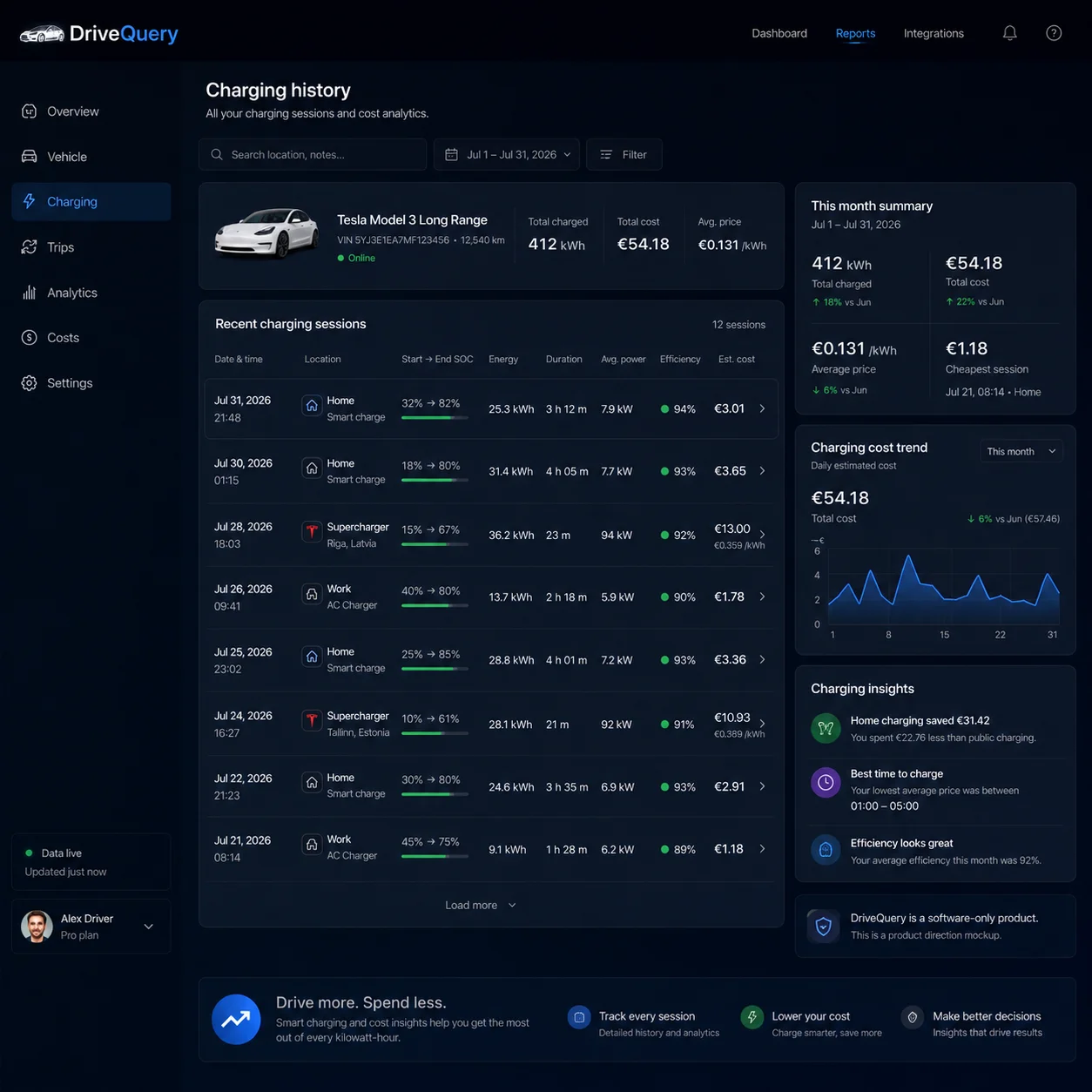
DriveQuery is designed to connect charging sessions with electricity prices, location and trip history so those answers stay visible without rebuilding them from separate apps.
Frequently asked questions about Tesla home charging
Can you charge a Tesla at home in the UK?
Yes. Use suitable home charging equipment and an electrical installation designed for the charging load.
How fast does a Tesla charge at home?
Tesla lists up to 7.4 kW for current Model S, 3, X and Y on 230 V single phase. Its UK domestic socket adapter is rated up to 2.3 kW.
How long does it take to charge a Tesla at home?
Divide the energy you need to add by the available charging power, then allow for charging losses and real-world power variation. A 35 kWh top-up is roughly five hours at 7 kW but over fifteen hours at 2.3 kW.
Do I need a Tesla Wall Connector?
No. Tesla recommends Wall Connector for home use, but Mobile Connector and other compatible charging equipment can also work.
How much does Tesla home charging cost?
Multiply the wall energy used by the electricity price that applied while charging. On time-of-use tariffs, the charging time changes the cost.
Can I get a UK grant for a home charger?
Some households can. Eligible renters and flat owners can currently receive 75% of eligible purchase and installation costs up to £500 per socket. Other current schemes have different eligibility.
Is a 3-pin plug enough?
It can be enough for small daily top-ups, but its maximum power is much lower than a dedicated home charger, so larger top-ups take much longer.
What is the cheapest time to charge at home?
Use the cheap window on a fixed off-peak tariff. With dynamic pricing, select the cheapest available intervals that still reach the target before departure.
Sources and last reviewed
Last reviewed: 15 August 2026. Tesla charging specifications and current UK grant information were checked against Tesla UK and GOV.UK.
Plug in at home. Let the charging plan do the thinking.
DriveQuery is being built to connect your Tesla, charging target and electricity prices so the car charges when it makes sense and is ready when you leave.