
Smart EV charging for Tesla
Smart charging for Tesla – charge around price and departure time
DriveQuery smart charging turns your battery target, departure time and electricity prices into a practical Tesla charging plan. A fixed schedule is enough when cheap hours never move; smart EV charging adds value when the best periods change.
Not sure which tariff to optimise? Compare leading UK EV tariffs with your own mileage in the EV tariff comparison calculator.
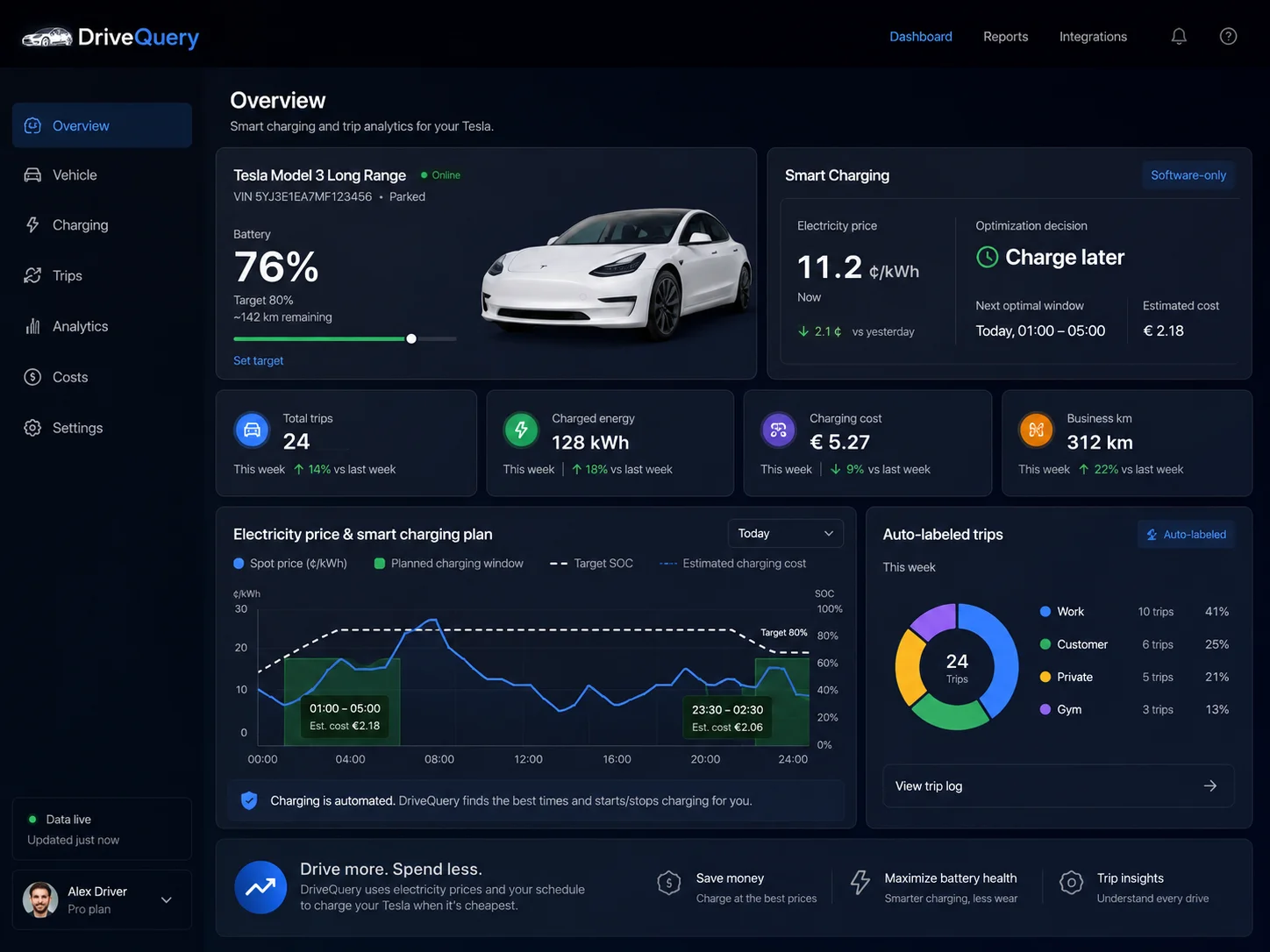
One decision, four inputs
Charge when it is cheap. Be ready when it matters.
DriveQuery turns a changing night into one clear plan — without treating every price movement as a reason to wake the car or send another command.
- Current battery level and target
- Ready-by time and required charging energy
- Eligible low-price intervals
- Manual charging and vehicle state
Automation that knows when to stop
The best charging command is often no command at all.
Price optimisation only works when it respects the car, the deadline and the driver. These are the guardrails behind the plan.
Ready comes first
A cheap charging slot is no use if the car is not ready when you need it. DriveQuery protects your battery target and deadline before chasing the lowest price.
Let a sleeping Tesla sleep
If the car is asleep, DriveQuery can use the latest reliable battery, target and location data instead of waking it just to ask for the same information again.
Your manual charging takes priority
If you start charging yourself, DriveQuery lets it continue instead of immediately stopping it.
Only change what needs changing
If the existing plan is still right, DriveQuery leaves it alone. Small changes in battery level do not trigger a new plan unless they actually matter.
Smart charging, Tesla schedules and charging plans: what is the difference?
These phrases are often used as if they mean the same thing, but they describe different levels of control. Tesla already provides charging schedules in the vehicle and Tesla app. Smart EV charging adds a price-aware planning layer for situations where the cheapest valid charging periods can move from day to day.
| Term | What it means | Best fit |
|---|---|---|
| Tesla charging schedule | A recurring start/stop or ready-by charging rule for a location. | Predictable off-peak windows. |
| Tesla charging plan | The actual set of charging periods needed to reach the battery target before departure. | Turning a target and deadline into a workable night plan. |
| Smart EV charging | Automation that can adapt the Tesla charging plan when prices or the vehicle state change. | Dynamic or frequently changing electricity prices. |
If your electricity tariff is cheap at exactly the same time every night, Tesla's own schedule may already do the job. If the tariff changes by half-hour or quarter-hour, the useful question becomes: which eligible periods should the car use tonight? For deeper price optimisation, see Tesla dynamic tariff charging.
Cheap is only useful if the car is ready on time
DriveQuery starts with two things: how much charge you need and when the car must be ready. It keeps enough margin to reach the target, then fills the remaining charging need with the lowest-cost eligible intervals. Saving the last few cents never takes priority over being ready to leave.
15-minute prices deserve 15-minute decisions
Where electricity prices change every 15 minutes, DriveQuery can plan charging at the same resolution. It can combine several low-cost windows instead of relying on one fixed overnight start time.
An example night, turned into a plan
Illustrative only: DriveQuery can select separate low-cost intervals instead of one fixed start time.
A lower price is not a reason to wake the car
Teslas spend much of their parked time asleep. DriveQuery uses the latest reliable state when that is enough to make the next decision. A lower electricity price alone is not a good reason to wake the car just to request information the system already has.
No repeated commands for the sake of it
If the plan already on the car is still the right one, DriveQuery leaves it alone. Small changes in battery level are tolerated rather than triggering constant replanning. And if a non-urgent update can wait until the car reconnects on its own, it does.
You stay in control
If you start charging manually, DriveQuery treats that as an intentional choice. Automation should work quietly in the background, not fight you for control of the car.
What DriveQuery smart charging already handles
- Battery target and ready-by time come before price optimisation
- 15-minute price planning where supported
- Enough safety margin to reach the battery target reliably
- No waking the car just to re-check data DriveQuery already has
- No repeated commands when the schedule is already right
- Small battery-level changes do not trigger needless replanning
- Charging you start yourself is not automatically stopped
- Non-urgent changes can wait until the car reconnects naturally
If you are comparing charging methods first, start with the Tesla charging UK guide. To understand the cost before optimising it, see how much it costs to charge an electric car in the UK. If your main goal is to follow dynamic electricity prices, see Tesla dynamic-tariff charging. For Nordic spot-price context, see Nord Pool Tesla charging. For a practical tariff-first workflow, use the cheapest-time charging guide.
Frequently asked questions
What is smart EV charging?
Smart EV charging adjusts when the car charges using inputs such as electricity price, battery target and departure time. Instead of relying only on one fixed start time, it can favour lower-cost eligible periods while keeping the car ready when needed.
Can you set a charging schedule on a Tesla?
Yes. Tesla supports charging schedules from the vehicle and Tesla app. A fixed schedule works well when the cheap electricity window is predictable.
What is a Tesla charging plan?
A charging plan is the set of charging periods needed to move from the current battery level to the requested target before the car must be ready.
When does Tesla smart charging add value?
Smart charging is most useful when electricity prices change inside the parked window. The plan can then favour cheaper eligible periods while protecting the battery target and departure deadline.
Smart enough to leave things alone.
Optimise when it matters. Leave the car alone when it does not.