
Nord Pool · Tesla · Smart charging
Nord Pool gives you the market price. A charging plan decides when your Tesla should actually charge
Nord Pool prices are useful inputs — not charging instructions. The car still has a location, a battery target, a charging limit and a deadline. Smart charging works when those constraints are matched with the price your electricity contract actually passes through.
Illustrative price profile
The cheapest periods may be scattered across the night.
This is not today’s market data. It illustrates the planning problem: if the Tesla is plugged in for many hours but only needs a few hours of energy, charging can be shifted away from expensive periods — provided your retail tariff actually reflects that price signal.
Nord Pool is one layer of the decision. It can tell you what electricity is worth in a wholesale market and bidding zone. It cannot tell you how many kWh your Tesla needs, when you are leaving, what your supplier adds to the price or whether your retail contract is hourly, quarter-hourly, half-hourly or a fixed EV window.
What Nord Pool actually provides
Nord Pool operates day-ahead and intraday power markets across several European countries. For a Tesla owner, the most useful concept is the bidding zone: the wholesale price is location-specific rather than one universal “Nord Pool price”.
In the Nordic and Baltic markets this matters immediately. Finland has one FI area. Sweden is split into SE1–SE4, Norway into NO1–NO5 and Denmark into DK1–DK2. Estonia, Latvia and Lithuania also have their own delivery areas. Two drivers charging at the same time can therefore face different wholesale reference prices before their retail contract adds anything else.
| Market | Relevant area | What a charging service should avoid |
|---|---|---|
| Finland | FI | Using a generic Nordic average instead of the Finnish area price |
| Sweden | SE1–SE4 | Assuming Stockholm and Malmö necessarily have the same wholesale signal |
| Norway | NO1–NO5 | Ignoring the car’s actual charging location and electricity contract |
| Denmark | DK1–DK2 | Ignoring both the bidding zone and time-dependent network tariffs |
| Baltics | EE · LV · LT | Treating the region as a single price area |
| Great Britain | GB wholesale market | Copying Nordic retail assumptions instead of following the customer’s actual UK tariff |
15-minute day-ahead prices do not automatically mean 15-minute household billing
The Single Day-Ahead Coupling moved to a 15-minute Market Time Unit for delivery from 1 October 2025. In markets using that structure, a normal 24-hour day therefore contains 96 day-ahead periods rather than 24 hourly periods.
That is useful resolution for optimisation, but there is an important boundary: wholesale resolution and retail billing resolution are not the same thing. Your electricity supplier may expose the market signal per quarter-hour, per hour or through another tariff model. In Great Britain, for example, EV tariffs can use fixed off-peak windows or dynamic half-hourly prices. The optimiser should follow what the customer actually pays.
Your final charging cost contains more than the exchange price
| Cost component | Can timing affect it? | Why it matters |
|---|---|---|
| Wholesale / spot-linked energy price | Often yes | This is the main Nord Pool-related signal in a dynamic contract. |
| Supplier margin or spread | Depends on contract | Some suppliers add a fixed margin; others package pricing differently. |
| Taxes and VAT | Usually not minute by minute | They can dominate the final bill even when wholesale electricity is cheap. |
| Network / distribution charges | Sometimes | Some markets use time-dependent tariffs or capacity-based elements. |
| Subscription / fixed fees | No | They affect total ownership cost, not the best individual charging period. |
This is why a negative or near-zero wholesale price does not automatically mean free charging. The retail bill can remain positive after network charges, taxes, supplier fees and VAT.
If you want to translate the tariff into an actual vehicle cost, use the UK electric car charging cost calculator. For the charging-control side, see smart charging for Tesla.
A Tesla charging plan starts with the car, not the market
Imagine the car is plugged in at 18:00 and must be ready at 07:00. It needs 38 kWh to reach the chosen target and can draw up to 11 kW AC.
The parking window is 13 hours. At a theoretical 11 kW, 38 kWh takes roughly 3.5 hours — about 14 quarter-hour periods if the applicable tariff is genuinely quarter-hourly. The full 13-hour window contains 52 quarter-hours. That gap is the flexibility: the plan can choose enough lower-cost periods without sacrificing the departure target.
Real charging power varies. Charging losses, battery temperature, the onboard charger, household load limits and a safety margin before departure all matter. A good plan should therefore reserve enough time rather than assume 38 ÷ 11 is exact in the real world.
What changes for a driver in Great Britain?
Nord Pool is not only a Nordic exchange. Elexon lists Nord Pool as one of the power exchanges used for short-term electricity trading in Great Britain. But that does not mean a British Tesla owner should optimise against a Scandinavian bidding-zone price.
For a UK household, start with the actual retail tariff. A fixed EV tariff may simply reward using a known off-peak window. A dynamic tariff may expose half-hourly prices. The relevant optimisation problem is therefore the one explained in our UK guide to charging a Tesla at the cheapest time.
What a robust smart-charging rule needs
Where DriveQuery fits
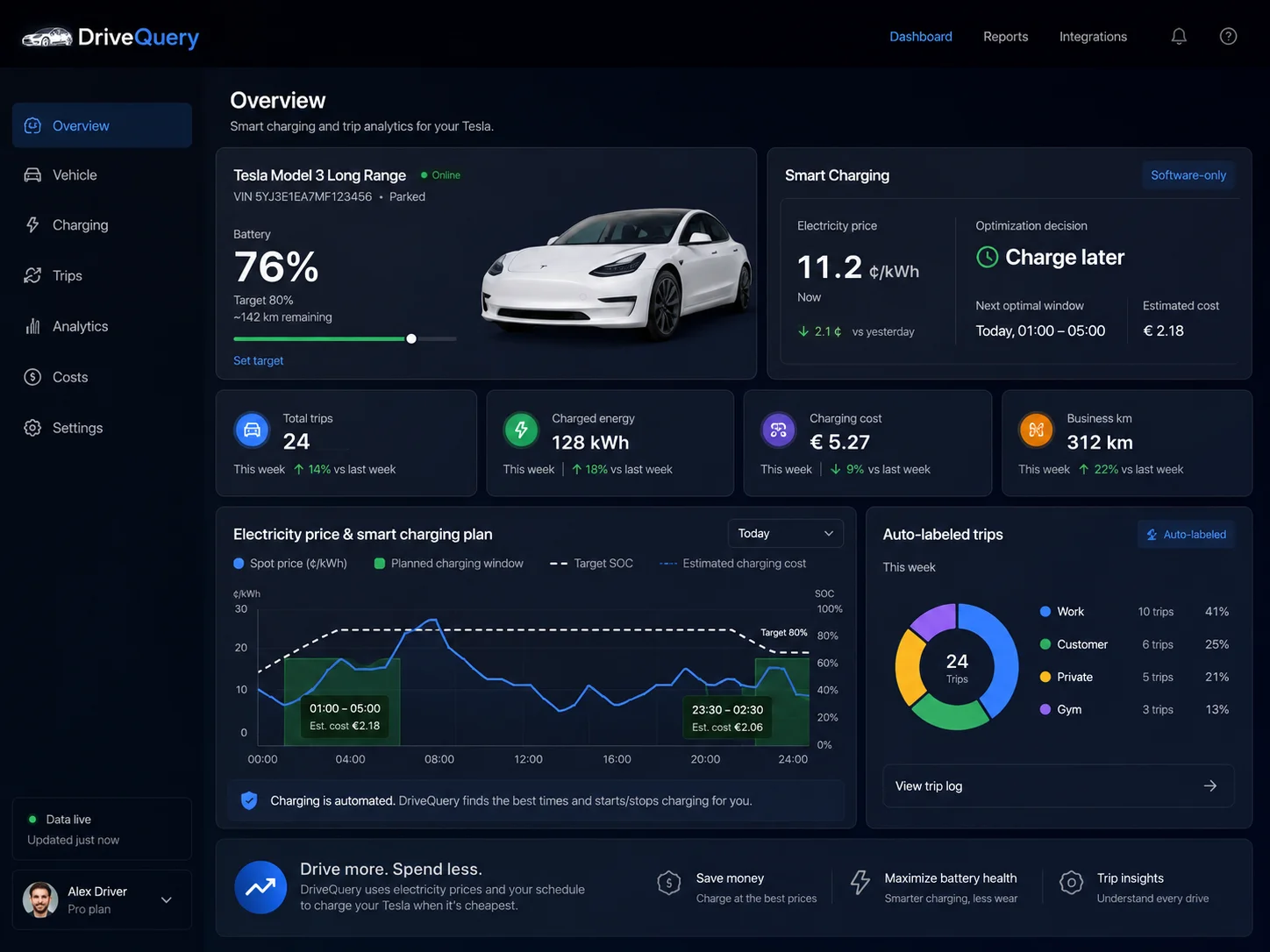
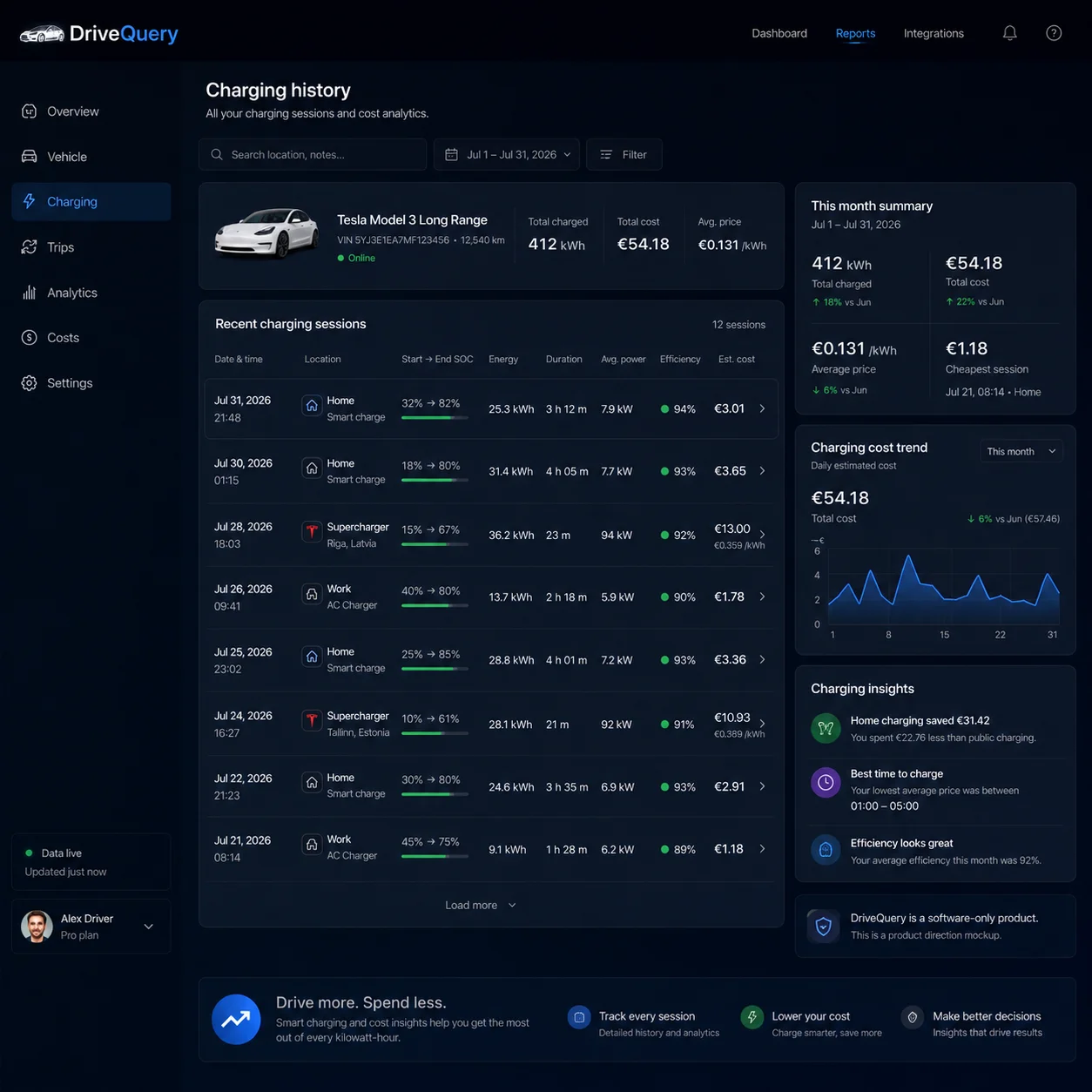
DriveQuery is being built around the difference between price data and a usable vehicle plan. The intended flow is simple: identify where the Tesla is charging, use the applicable electricity price, estimate the energy needed and place charging into the best available periods before the driver’s deadline.
When does Nord Pool optimisation create the most value?
| Situation | Value of price-aware charging | Reason |
|---|---|---|
| Dynamic retail tariff closely follows wholesale prices | High | Moving kWh changes the price paid for those kWh. |
| Car is parked for many hours but needs only a few hours of energy | High | There is plenty of flexibility to choose better periods. |
| Fixed cheap EV window every night | Moderate | Simple scheduling may already capture most of the value. |
| Flat fixed-price electricity contract | Low for energy price | Wholesale movements may not change the customer’s unit rate. |
| Car needs immediate charging to meet an early departure | Low | The energy requirement leaves little flexibility. |
Frequently asked questions
Does Nord Pool set the price I pay to charge my Tesla?
No. Nord Pool is a wholesale power market. Your supplier determines how that market signal reaches your contract, and the final bill can also include taxes, network charges, VAT and supplier fees.
Why does the Nord Pool price area matter?
Wholesale prices are tied to bidding zones. Finland uses FI, Sweden SE1–SE4, Norway NO1–NO5 and Denmark DK1–DK2, with separate areas in the Baltic states. The charging location therefore matters.
Are Nord Pool day-ahead prices 15-minute prices?
In the Single Day-Ahead Coupling markets that moved to the 15-minute MTU, delivery from 1 October 2025 uses 15-minute periods. A normal day has 96 periods. Your retail tariff can still use a different billing interval.
Is Nord Pool relevant in Great Britain?
Yes. Nord Pool operates in the British wholesale market too. But UK households should optimise against their actual retail EV or dynamic tariff, not copy Nordic bidding-zone assumptions.
Should the Tesla always charge in the single cheapest period?
No. The objective is enough energy before departure at the lowest practical cost. A typical overnight top-up needs several periods, and charging power and losses need to be allowed for.
Can negative wholesale prices make charging free?
Not automatically. Other retail cost components can keep the final charging price positive even when the wholesale component is negative.
What information does a smart charging plan need?
At minimum: location, retail tariff, battery state, target state of charge, available charging power, departure deadline and rules for manual override or minimum battery protection.
Sources
DriveQuery early access
Let the car’s deadline and your electricity price work together.
Join the waitlist and help shape smart charging built around real Tesla usage.