
Business mileage tracker app
Business mileage tracker for Tesla – automatically record journeys
Use a mileage tracker app to capture Tesla journeys as they happen, then review business, private and commuting trips before month-end. DriveQuery is designed to keep the factual trip record automatic while leaving the final HMRC classification with the driver or business.
Looking for the car’s total mileage, odometer and mileage history? Start with the Tesla mileage guide. For HMRC rates and claim calculations, use the HMRC mileage rates calculator.
What a business mileage tracker should do
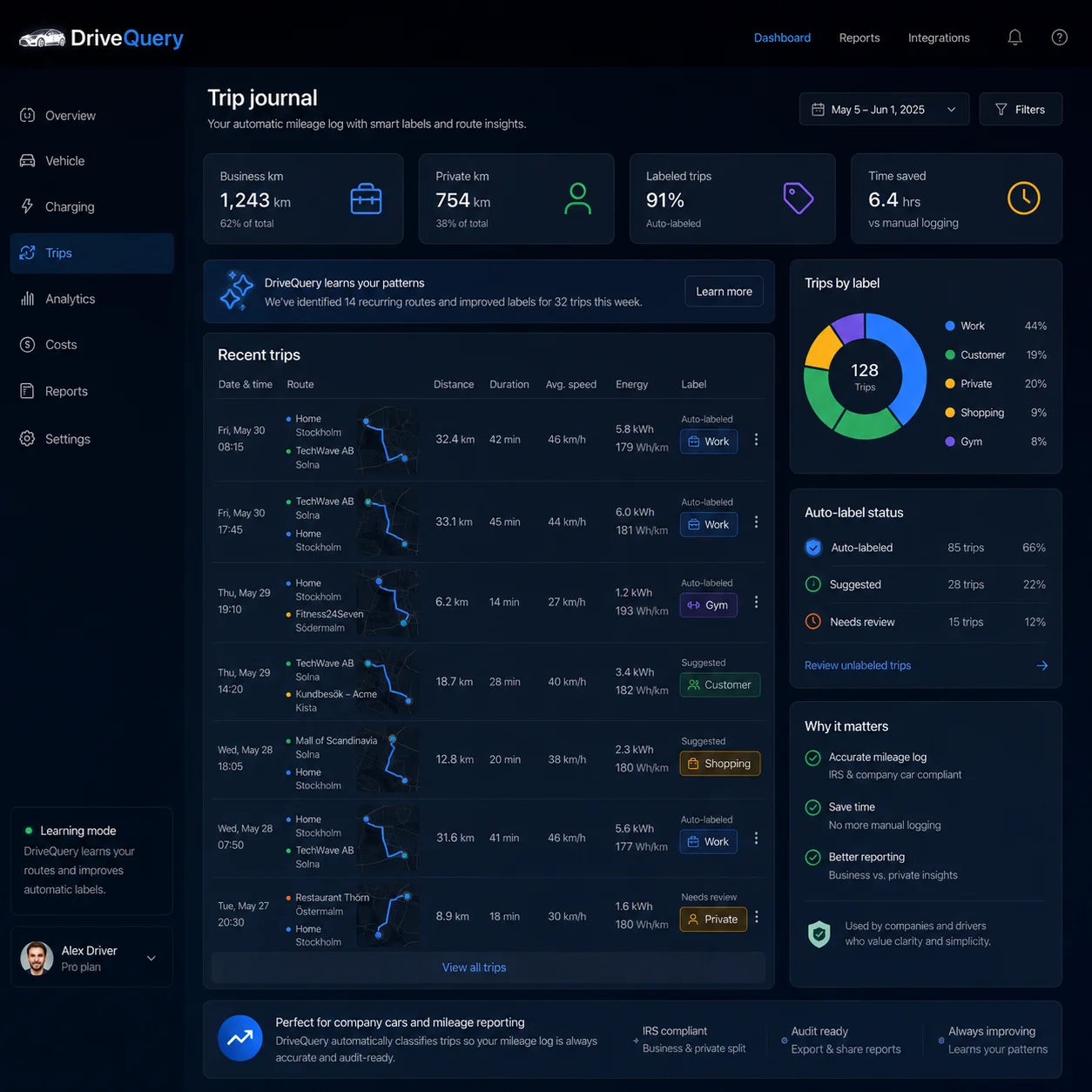
Trips captured automatically
Start with the journeys your Tesla actually made instead of rebuilding a month from diary entries and memory.
Business or private
Keep the route facts separate from the business purpose, so the driver can review and confirm the classification.
Recurring places
Label customers, offices, warehouses and other familiar destinations so repeated journeys become faster to review.
Period reports
Roll reviewed journeys into monthly mileage totals and planned CSV/PDF exports for expenses and accounting.
A business mileage tracker is useful only when the journey record is correct
The arithmetic is simple: eligible business miles multiplied by the relevant rate. The difficult part is creating a reliable list of those miles in the first place. At month-end, drivers often remember the obvious client visits but forget the short detour to a supplier, the journey between two workplaces or the day they drove their normal commute and then continued to a customer.
A useful mileage tracker app should begin with the journey record, not with a mileage-rate calculator. It should capture when the car moved, where the journey started and ended, how far it travelled and enough context for the driver to decide whether that journey was business, private or ordinary commuting.
For businesses, the important benefit is less month-end reconstruction: a mileage tracker keeps the trip timeline ready for review, while a mileage tracker app makes that workflow available without a separate in-car logging device.
A Tesla can provide route, time and distance context. Whether a journey qualifies as business travel depends on the facts of the employment or business. DriveQuery is designed to automate the factual record while keeping the final purpose review visible.
What should a business mileage tracker app record?
| Field | Why it matters |
|---|---|
| Date and time | Places the journey in the correct expense period and helps match it to meetings, jobs or customer visits. |
| Start and destination | Shows what the journey actually connected instead of storing only a mileage total. |
| Distance | Provides the basis for mileage reimbursement or a self-employed mileage calculation. |
| Odometer context | Helps identify gaps, duplicate journeys or suspicious changes in the trip sequence. |
| Business / private / commute | Separates potentially claimable mileage from private travel and ordinary commuting. |
| Business purpose | Explains why the journey was made: customer visit, site inspection, supplier, training or another work reason. |
| Place labels | Makes repeated destinations easier to recognise without assuming that every familiar place is automatically Home or Work. |
| Review status | Shows which journeys have been checked and which still need the driver's attention. |
Three UK cases that should not be mixed together
“Business mileage” can mean different things depending on who owns the Tesla and why the mileage is being recorded.
| Situation | Main mileage rule | What the tracker is proving |
|---|---|---|
| Employee uses their own Tesla | Approved Mileage Allowance Payments (AMAP) | Eligible business miles in the employee's own vehicle |
| Employee drives a company Tesla | Company-car mileage / Advisory Electric Rate context | Business versus private miles and, if relevant, electricity reimbursement |
| Sole trader uses a Tesla for the business | Simplified mileage or actual-cost method | Contemporaneous business mileage supporting the chosen accounting method |
The same trip history can support all three workflows, but the rate and tax treatment are not interchangeable.
If the employee owns the Tesla: 55p and 25p from 6 April 2026
For the 2026–27 tax year, HMRC's approved mileage rates for an employee using their own car or van are 55p per business mile for the first 10,000 business miles and 25p per mile above 10,000. The 10,000-mile threshold applies across cars and vans used in the same employment rather than restarting for each vehicle.
For example, if a driver has not yet reached 10,000 business miles in the tax year and records 684 eligible miles in a month:
The employer may pay at, below or above the approved amount, but the tax treatment changes accordingly. Where the employer pays less than the approved amount, the employee may be able to claim Mileage Allowance Relief on the qualifying shortfall. That is tax relief on the difference, not automatically a cash repayment of the whole difference.
HMRC also requires employers to retain records of mileage payments and the business journeys to which those payments relate. This is where an actual trip log matters more than a total typed into an expense form.
For the current rates, thresholds and a quick calculation, see the HMRC mileage rates 2026/27 calculator.
Ordinary commuting is not automatically business mileage
A mileage tracker should not simply mark “journey made on a workday” as business. HMRC generally treats travel between home and a permanent workplace as ordinary commuting, for which there is normally no tax relief. Travel to a temporary workplace can be different, but the temporary-workplace rules depend on the facts and include safeguards such as the 24-month rule.
That means automatic classification should be conservative. A familiar office can be labelled so the driver recognises it immediately, but the software should not silently convert every journey to that office into a claimable business trip.
See the temporary workplace and business-mileage guide for the UK rules behind this distinction.
If the Tesla is a company car: business mileage still matters
A company Tesla does not use the employee-owned AMAP rate. The mileage log is still useful because employers may need to separate business travel from private travel and because electricity reimbursement can depend on business mileage.
From 1 June 2026, HMRC's Advisory Electric Rates for fully electric company cars are 7p per mile for home charging and 15p per mile for public charging. HMRC describes these as advisory rates for company-car electricity; they are not the same as the 55p/25p employee-owned-car mileage allowance.
If a company car is charged at both home and public locations, a mileage tracker plus charging history can make it easier to support a fair split. For the charging side, see our Tesla home-charging reimbursement guide.
If you are self-employed: keep the mileage while it is happening
Sole traders and qualifying partnerships can choose simplified vehicle expenses instead of calculating actual vehicle costs, subject to HMRC's eligibility rules. For cars and goods vehicles, the 2026–27 simplified mileage rates are also 55p for the first 10,000 business miles and 25p thereafter.
HMRC's Business Income Manual stresses the importance of maintaining a contemporaneous record of business mileage to support a flat-rate claim. This is exactly why reconstructing a year's mileage from calendar entries shortly before Self Assessment is a weak workflow.
If simplified mileage is used, the flat rate covers vehicle running costs; you do not separately add electricity, insurance, servicing and similar vehicle expenses on top of the mileage amount. The accounting choice therefore comes before the calculation.
See the sole-trader mileage log guide for the wider workflow.
What automatic Tesla data can do — and what it cannot
DriveQuery's planned mileage workflow starts with Tesla trip data. That can remove much of the typing, but it should not pretend that telemetry contains the full business context.
| Can usually be derived from vehicle data | Usually needs driver or business context |
|---|---|
| Journey start and end time | Was this business, private or ordinary commuting? |
| Start and destination location | Who or what was visited? |
| Distance and odometer movement | What was the business purpose? |
| Repeated destinations | Does the journey qualify under the relevant tax rule? |
| Potential gaps or unusual trip segmentation | Is the expense claim complete and approved? |
This is why DriveQuery is designed around review rather than blind automation. The software can reduce the number of things a driver has to type, while the final classification remains explicit.
A real day: four journeys, only two business trips
| Journey | Distance | Likely classification | Reason to review |
|---|---|---|---|
| Home → permanent office | 18.2 mi | Ordinary commute | Normally not business mileage |
| Office → Client A | 27.6 mi | Business | Customer visit |
| Client A → supplier | 11.4 mi | Business | Collect equipment |
| Supplier → gym | 9.8 mi | Private | Personal destination |
The business total is 39.0 miles, not 67.0 miles. A tracker that knows only “the Tesla travelled 67 miles today” is not enough. The value comes from keeping the individual journeys and their purpose separate.
Recurring destinations should save time, not make tax decisions
A customer office visited every Tuesday should not need to be typed from scratch every week. DriveQuery can learn a user-defined place label such as Client A, Warehouse or London Office and use that to make the next review faster.
But the label is context, not proof. The same destination can sometimes be business and sometimes private, and a familiar office may be a permanent workplace rather than claimable mileage. Suggestions should therefore remain reviewable.
What happens when a journey is missing or split incorrectly?
A business mileage record also needs quality control. A weak tracker can produce a polished total that is still wrong if one journey disappeared or two journeys were merged together.
- Check odometer continuity. A jump between consecutive trips can reveal missing distance.
- Review unusually long trips. They can indicate two journeys that were merged across a stop.
- Keep partial GPS data separate from trip existence. A route line can be incomplete even when the distance and journey record are still usable.
- Do not invent purpose. If the trip exists but the reason is unknown, mark it for review rather than classifying it automatically.
For recovery and diagnostics, see Tesla trip history missing.
Build the mileage log continuously, then close the month
- Capture journeys automatically. Keep each Tesla trip as its own record.
- Apply familiar place labels. Make the timeline readable without making hidden tax assumptions.
- Review exceptions. Confirm trips with an unknown or unusual purpose.
- Separate business, private and commute mileage. Do not wait until the expense claim is being submitted.
- Check continuity. Look for gaps, duplicates and implausible segments.
- Calculate the relevant period. Apply the employee-owned, company-car or self-employed rule that actually fits the vehicle.
- Export the reviewed record. Keep the journey detail behind the headline mileage total.
What should a monthly business-mileage report show?
A useful report should be understandable without opening the app. At minimum it should show the reporting period, vehicle, total mileage, eligible business mileage and enough journey detail to explain the total.
| Summary | Journey detail |
|---|---|
| Reporting period | Date and time |
| Total business miles | Start and destination |
| Rate / calculation method | Distance |
| Calculated amount where relevant | Business purpose / classification |
| Vehicle / driver context | Review status or notes |
For data portability, see Tesla trip-history export. The goal is not only to create a number, but to preserve the journeys that explain it.
DriveQuery's approach
DriveQuery is being built to remove repetitive mileage admin while leaving the important judgement visible:
- capture Tesla journeys automatically;
- retain route, time, distance and odometer context;
- let users create their own meaningful place labels;
- suggest classifications for recurring patterns without silently finalising them;
- surface journeys that need attention;
- produce period totals only from reviewed trips; and
- support planned CSV/PDF exports for expenses, accounting and record keeping.
The tracker can organise Tesla journey data and make a mileage workflow easier to audit. The employer, employee or business remains responsible for deciding whether a journey qualifies under HMRC rules.
Frequently asked questions
What is a mileage tracker app?
A mileage tracker app records journeys and distance so business mileage can be reviewed without rebuilding trips from memory. For a Tesla, DriveQuery is designed to use authorised vehicle data to capture trip facts, while the driver still confirms whether each journey was business, private or ordinary commuting.
What is the UK mileage rate for using my own Tesla for business in 2026?
For the 2026–27 tax year, HMRC's approved car and van rate is 55p per business mile for the first 10,000 business miles and 25p per mile above 10,000. These rates apply to qualifying business mileage in the employee's own vehicle, including an electric car.
Does the 55p rate apply to a company Tesla?
No. The AMAP rate is for an employee using their own vehicle. A company Tesla is a different case. For reimbursing electricity used for company-car business mileage, HMRC publishes Advisory Electric Rates; from 1 June 2026 these are 7p per mile for home charging and 15p per mile for public charging.
Can I claim my normal commute as business mileage?
Usually not. Travel between home and a permanent workplace is generally ordinary commuting. Journeys to temporary workplaces and travel between workplaces can be treated differently, depending on the facts.
What evidence should an employer keep for mileage payments?
HMRC requires employers to keep records of mileage payments and the business journeys to which they relate. A useful mileage record therefore keeps the journey date, distance and enough context to support why it was treated as business travel.
Can DriveQuery decide automatically whether every journey is business?
No. It can automate the factual journey record and make recurring journeys easier to review, but it should not invent the business purpose. The driver or business should confirm the final classification.
Can a sole trader use the same mileage rates?
Eligible sole traders and partnerships can use HMRC simplified mileage rates. For cars and goods vehicles in 2026–27, those rates are 55p for the first 10,000 business miles and 25p thereafter. Eligibility and the choice between simplified mileage and actual costs still matter.
Should I record only business trips?
It is often safer to retain the trip sequence and then classify it. That makes gaps easier to detect and gives a clearer business/private split. The report can still include only the journeys relevant to the purpose for which it is being produced.
Do I need a separate GPS tracker in the Tesla?
DriveQuery's planned approach uses authorised Tesla vehicle data rather than a separate GPS box. The important distinction is that vehicle data supplies trip facts; it does not replace the user's responsibility to confirm the business reason and tax treatment.
Official sources and related guides
- HMRC: business travel mileage for employees' own vehicles
- HMRC: Mileage Allowance Payments rates
- HMRC: Advisory Electric Rates for company cars
- HMRC: ordinary commuting and private travel
- HMRC: simplified vehicle expenses for the self-employed
- Tesla mileage and mileage log guide
- Export Tesla trip history
- Tesla home-charging reimbursement
Stop rebuilding business mileage at month-end.
Join the waitlist if you want your Tesla journeys ready to review before the expense deadline arrives.