
Tesla home charging reimbursement
Reimburse Tesla home charging without turning every month into a spreadsheet exercise
A practical UK guide to company-car home charging: what HMRC allows, what evidence an employer may need, how advisory electric rates differ from actual electricity cost, and how Tesla charging data can support a reviewable monthly record.
What a home-charging reimbursement record should contain
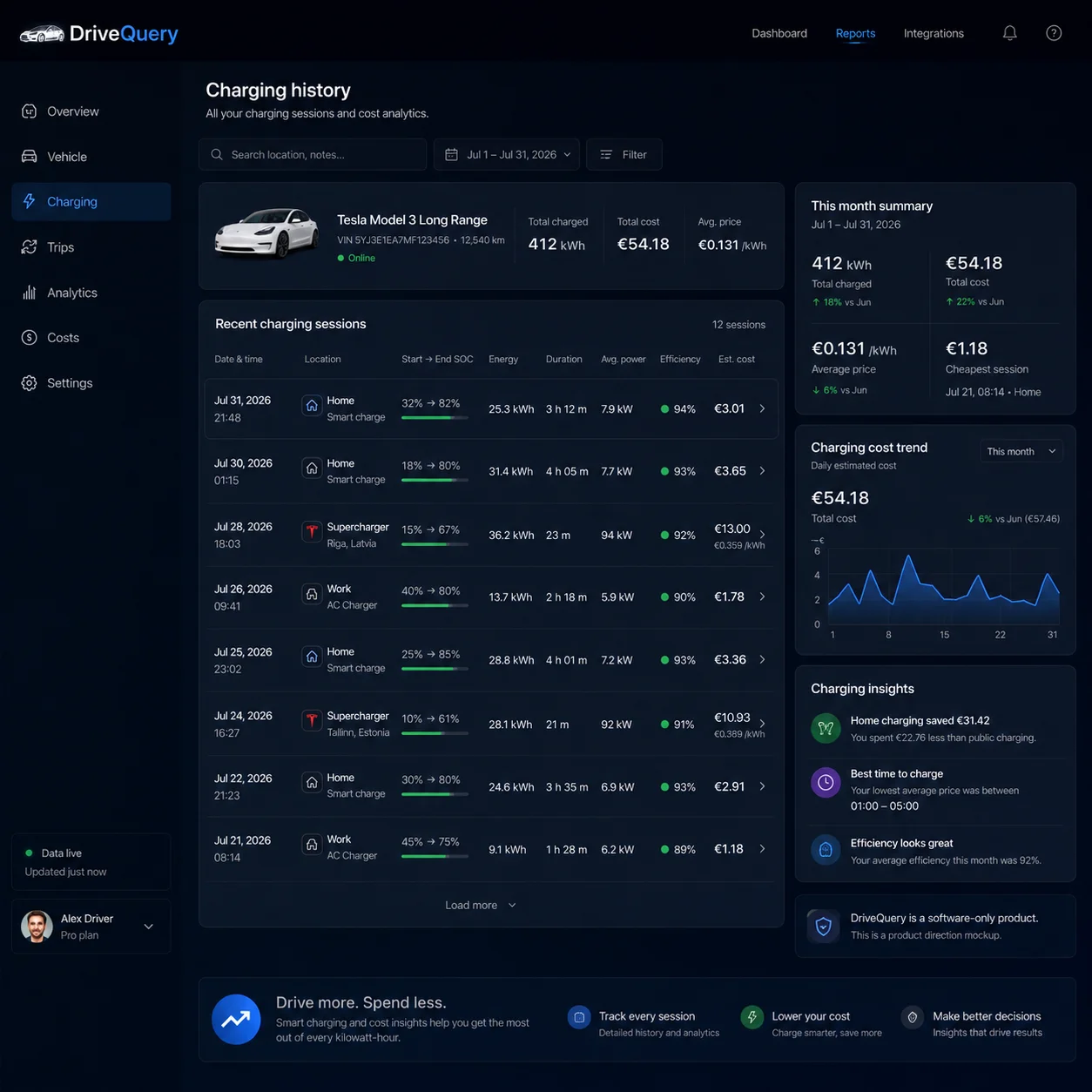
Energy per session
Keep the charging session and energy added together instead of rebuilding the month from screenshots.
Cost context
Apply the relevant home tariff or dynamic-price context to estimate the electricity cost.
Monthly reporting
Planned exports are designed for expense and employer reporting, with the underlying sessions still visible.
Home location
Separate charging at home from work, public charging and other locations.
Home charging reimbursement is really an evidence problem
Charging a company Tesla at home is easy. Reimbursing it cleanly is harder. The employer needs to know that the electricity relates to the company car, the employee needs a repeatable way to show what was charged, and payroll or finance needs a method that can be explained later.
For a UK company electric car, HMRC's current guidance is more helpful than many people assume: an employer can reimburse the employee for electricity used to charge the company car at home or at a public charger without a separate benefit-in-kind charge. The important condition is that the reimbursement must relate solely to the company electric car.
HMRC distinguishes a company car from an employee's own car. This page focuses on a Tesla supplied as a company car. If you use your own Tesla for business journeys, mileage allowance rules are normally the more relevant starting point.
What HMRC says in 2026
For a fully electric company car, there are two practical reimbursement routes that employers commonly consider:
| Approach | What it uses | When it is useful |
|---|---|---|
| Advisory Electric Rate (AER) | Miles × HMRC advisory rate | Simple mileage-based reimbursement for company-car electricity |
| Actual / evidenced electricity cost | Measured or supportable charging cost | When the employer wants to reimburse the electricity actually attributable to the company car |
From 1 June 2026, HMRC's advisory electric rates for fully electric company cars are 7 pence per mile for home charging and 15 pence per mile for public charging. HMRC also allows a higher amount where the employer can show that the real cost per mile was higher. If a company car is charged at both home and public locations, HMRC says the mileage can be apportioned on a fair and reasonable basis.
The AER is therefore a useful shortcut, but it is not the same thing as reimbursing a household electricity bill by kWh. A session-level charging record is most valuable when the employer chooses or requires the second route, or wants evidence behind a rate that differs from the advisory figure.
AER and kWh reimbursement answer different questions
Suppose an employee drives 620 business miles in a month and the company uses the 7p home-charging AER. The mileage reimbursement would be:
Now imagine the same Tesla charged 176.4 kWh at home during the period and the agreed electricity cost was 22.5p/kWh. A kWh-based calculation would be:
Those numbers do not have to match. One is an advisory cost-per-mile method; the other attempts to reimburse electricity attributed to home charging. The employer should decide which policy it uses and document that method consistently rather than mixing the two silently.
What a useful home-charging record should contain
| Field | Why it matters |
|---|---|
| Date and time | Shows when the charging session occurred and lets a tariff be matched to the correct period. |
| Vehicle | Connects the electricity to the company Tesla rather than another household EV. |
| Charging location | Separates home charging from work, Supercharging and other public locations. |
| Energy | Provides the kWh basis for a session-level calculation. |
| Price basis | Explains whether the cost came from a fixed tariff, time-of-use tariff, dynamic price, meter or another agreed method. |
| Calculated amount | Shows how the reimbursement total was built. |
| Period total | Gives payroll or finance a simple monthly figure without hiding the underlying sessions. |
The principle is simple: the monthly total should be easy to read, but it should also be possible to open that total and see the sessions underneath it.
Fixed, time-of-use and dynamic tariffs need different treatment
For a separate household-cost estimate before reimbursement rules are applied, use the electric car charging cost calculator. It helps make the underlying tariff and kWh assumptions explicit.
Fixed tariff
If the employee pays one unit rate throughout the day, the calculation can be straightforward: eligible kWh multiplied by the agreed pence-per-kWh rate. Standing charges are a separate question and should only be included if the employer's policy and evidence support doing so.
Time-of-use tariff
On an EV tariff with cheap overnight hours, using a single household average can overstate or understate the real cost. A better record keeps the charging time beside the energy so the correct tariff window can be applied.
Dynamic tariff
With hourly or half-hourly pricing, the strongest calculation matches charging to the price interval that applied while the energy was consumed. A monthly average throws away exactly the information that made the dynamic tariff useful.
Solar generation
Solar makes “cost per kWh” more complicated. Electricity generated on the roof may have an opportunity cost, export value or employer-agreed valuation rather than the same cost as imported grid electricity. Vehicle telemetry alone cannot determine the household's true solar economics. If the reimbursement policy needs that distinction, meter or energy-management data should remain the source of truth.
Vehicle kWh is not always the same as wall-meter kWh
A Tesla and a home electricity meter can measure different points in the charging chain. Energy can be used by conversion losses, battery heating or cooling, vehicle systems and other charging overheads before it reaches the battery. That is why a vehicle-reported figure can differ from the electricity drawn at the wall.
For trend tracking and a practical employer report, vehicle data can be extremely useful. For a policy that requires exact billed household consumption or certified measurement, the wallbox, smart meter or other approved measurement source may be the stronger evidence.
DriveQuery can organise Tesla charging sessions and price context. It should not describe vehicle-side kWh as a certified electricity-meter reading.
What if there are two EVs at home?
This is where session identification matters. If the household has two electric cars, a total from the electricity bill or even a shared charger may not by itself prove how much energy went into the company Tesla.
A useful workflow should identify the relevant vehicle and keep only its eligible sessions in the employer report. If the employer requires certified charger-level separation, that requirement still takes priority over a vehicle-data estimate.
Company Tesla and privately owned Tesla are not the same tax case
HMRC treats reimbursement differently depending on who owns the car. For an employer-provided company EV, reimbursement of electricity used to charge that car can fall within the company-car exemption described above, provided the reimbursement is solely for that vehicle.
For an employee's own Tesla used for business travel, Approved Mileage Allowance Payments (AMAPs) are the more relevant framework. From 6 April 2026 the car-and-van AMAP rate is 55p per mile for the first 10,000 business miles and 25p thereafter. A flat home-charging allowance is not automatically the same thing as tax-free business mileage reimbursement.
See our Tesla business mileage tracker guide if the employee owns the car.
Tesla already has a Wall Connector reimbursement programme
Tesla's Wall Connector Reimbursement Program is available in the United Kingdom through a reimbursement partner. Tesla says the programme links Wall Connector energy consumption with tariff costs and can automatically submit the calculated amount to a participating employer.
That is an important reference point because it shows the problem is real — and also clarifies what DriveQuery should and should not claim. DriveQuery is independent of Tesla's reimbursement programme. Its role is to make Tesla vehicle and charging history easier to review, price and export, particularly where an employer already has its own expense process.
Tesla Wall Connector Reimbursement Program →
A practical monthly workflow
- Capture home charging sessions. Keep date, time, energy and the vehicle together.
- Exclude non-home charging. Supercharging, work charging and other locations may follow different reimbursement rules.
- Apply the employer's method. That may be HMRC's AER, an evidenced pence-per-kWh rate or another defensible company policy.
- Keep the price source visible. Do not hide whether the number came from a fixed tariff, dynamic tariff, meter or estimate.
- Review exceptions. Check unusual sessions, shared chargers and missing data before submitting.
- Export the period. Provide the headline total with enough session detail for finance to review it.
What DriveQuery is being built to do
DriveQuery's goal is not to become payroll. It is to remove the manual reconstruction between “I charged the company Tesla at home” and “here is a report we can review”.
- Detect and retain individual Tesla charging sessions.
- Identify home charging without forcing predefined home/work labels onto every trip.
- Keep kWh, timing and location together.
- Attach the relevant electricity-price context.
- Separate estimates from stronger billed or metered evidence.
- Roll sessions into monthly totals.
- Support planned CSV/PDF exports for employer and accounting workflows.
For the underlying session data, see Tesla charging history and Tesla charging-history export. If the tariff itself is the problem, see Tesla dynamic-tariff charging.
Frequently asked questions
Can my employer reimburse electricity used to charge a company Tesla at home?
Yes. HMRC says there is no separate benefit-code tax charge when an employer reimburses the electricity cost of charging a company electric car at home or at a public charging point, provided the reimbursement relates solely to the company car.
What is the HMRC advisory electric rate for home charging in 2026?
From 1 June 2026 the home-charging Advisory Electric Rate for fully electric company cars is 7 pence per mile. The public-charging rate is 15 pence per mile.
Can an employer pay more than the advisory electric rate?
HMRC says a higher amount can be used when the employer can show that the actual fuel/electricity cost per mile is higher. The evidence and calculation method therefore matter.
Do I need a special electricity meter?
Not in every employer policy. But if the policy requires exact household electricity consumption attributable to the company car, an approved wallbox or meter may provide stronger evidence than vehicle-side kWh. DriveQuery should complement, not overrule, that requirement.
Can I use my electricity tariff instead of 7p per mile?
Potentially, if the employer uses an evidenced actual-cost approach and the method satisfies its tax and payroll requirements. Keep the tariff source, eligible kWh and calculation visible.
What if I charge at home and at public chargers in the same month?
HMRC publishes separate home and public advisory electric rates and says mixed charging can be apportioned on a fair and reasonable basis. A session-level charging record makes that split easier to support.
Is a company Tesla treated the same as my own Tesla?
No. An employee-owned car used for business mileage falls under AMAP/Mileage Allowance Relief rules rather than the company-car electricity reimbursement treatment. Ownership should be established before choosing the calculation.
Does DriveQuery automatically reimburse the employee?
No. DriveQuery is being built to organise the charging evidence and reporting. It does not transfer money, run payroll or participate in Tesla's Wall Connector reimbursement programme.
Official sources and related guides
Make home charging easier to reimburse.
Join the waitlist and tell us whether employer charging reports are part of what you need.