
Tesla charging cost · 2026 US guide
How much does it cost to charge a Tesla?
At home, the math is simple: kWh added × your electricity rate. Using the U.S. EIA residential average for January through June 2026 — 18.16¢/kWh — a 60 kWh charging session is about $10.90 for electricity. Your actual rate may be much lower or higher.
FormulakWh × $/kWh
60 kWh at 18.16¢$10.90
Cheapest home windowYour off-peak rate
EIA national average is a benchmark, not a tariff quote. Latest available data on August 25, 2026: year-to-date through June 2026.
Charging cost calculator
Use your real kWh and electricity rate
Open the full Tesla charging calculator →
Enter the energy added in a session and the rate that applies while you charge. If your utility uses time-of-use pricing, use the off-peak or on-peak rate for the hours you actually charge.
Tip: For the closest real-world number, use energy from the charging session or electricity meter. Nominal battery capacity alone can miss charging losses.
What does a Tesla charge cost at different electricity rates?
The same 60 kWh session changes dramatically with the rate. This is why the answer to “how much does it cost to charge a Tesla?” depends more on where and when you charge than on one national Tesla price.
*U.S. Energy Information Administration: residential average electricity price, January–June 2026. State, utility and time-of-use rates vary widely.
Home charging
Your utility rate, time-of-use window and energy drawn determine the cost. Tesla says home charging is often the cheapest option.
Calculate home charging cost →Supercharging
There is no single nationwide Supercharger price. Use the price shown for the site and the actual session details in Tesla.
Review charging history →Other public charging
Network pricing can include energy, time, session or idle fees. The receipt or network app is the source of truth for that session.
Why “full charge cost” can be misleading
You rarely buy exactly one battery capacity
A charging session normally starts above 0% and ends below or at your daily charge limit. Model and battery configurations also vary. The cleanest calculation uses the kWh actually added, not an assumed “full battery.”
Wall energy and battery energy are not identical
Charging and vehicle systems consume some energy, so energy billed by your utility can exceed the energy retained in the battery. For cost tracking, session or meter energy is more useful than nominal battery capacity.
From cost to action
The cheapest time to charge depends on your utility plan
If your utility offers time-of-use pricing, the same kWh can cost less during off-peak hours. Tesla says owners may increase home-charging savings by switching to a time-of-use EV rate when available.
There is no universal US “cheap hour.” Weekday, weekend, season and utility rules can all change the low-cost window.
On-peak→Off-peak→Ready by departure
Tesla Charge Stats already estimates charging spend. What does DriveQuery add?
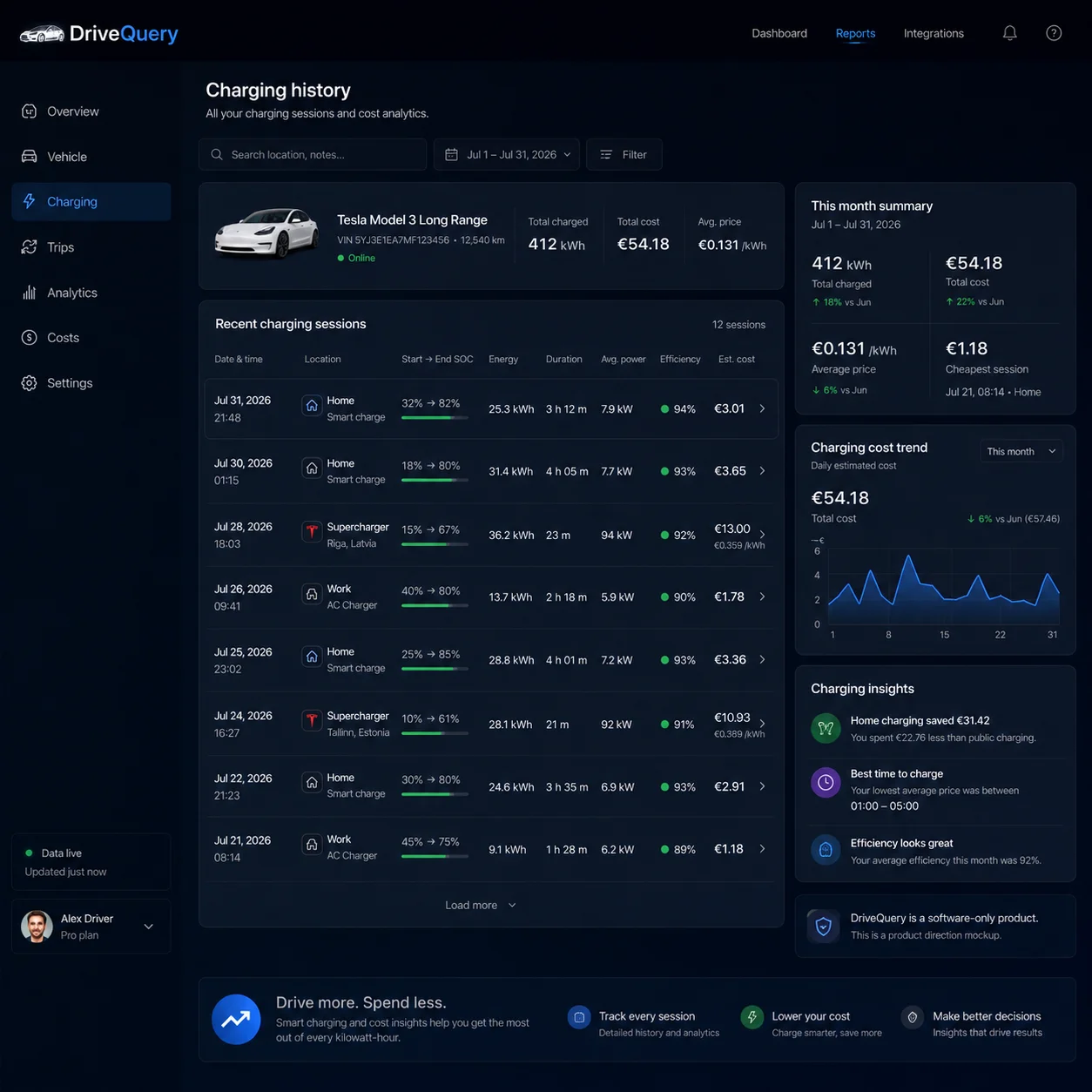
Tesla Charge Stats can show charged energy, estimated spend and average cost per kWh by charging location, and it supports custom and time-of-use home rates. DriveQuery is being built around the broader ownership record: charging sessions, trip history, user-defined places, cost context and charging automation together.
Understand
Which charging sessions made the month expensive, and how home, Supercharger and other charging contributed.
Act
Connect the rate window to when the car actually needs energy, instead of only reviewing cost after the fact.
Frequently asked questions
How much does it cost to charge a Tesla at home?
Multiply the kWh added by the electricity price that applies during the charging period. Using the U.S. EIA residential average for January through June 2026, 18.16¢/kWh, a 60 kWh session is about $10.90 for electricity. Your own utility rate can differ substantially.
How do I calculate Tesla charging cost?
Use energy purchased in kWh × price per kWh. For home charging, use the relevant utility rate. For public charging, use the site price and any applicable fees shown for the session.
Is charging at home cheaper than Supercharging?
Tesla says home charging is often the cheapest option. Your actual comparison depends on your utility rate, off-peak periods and current public-charging prices.
What is the cheapest time to charge a Tesla at home?
If you have time-of-use pricing, it is generally the applicable off-peak window. Exact hours vary by utility and rate plan, so there is no single nationwide cheapest time.
Do charging losses affect the cost?
Yes. Energy drawn from the wall can be higher than the energy retained in the battery. For the closest cost estimate, use the energy recorded for the charging session or by your electricity meter.
Primary sources used for this guide
Related DriveQuery guides
Know what charging cost. Then make the next session cheaper.
DriveQuery connects Tesla charging history with rate context so cost becomes something you can understand — and eventually optimize automatically.
Need a charger away from home?
Open the US charging map and filter Tesla, Electrify America, ChargePoint, EVgo, connector type and charging power.