
When the vehicle was used for the business trip.
Can be captured automaticallyIRS mileage log requirements
Mileage log for taxes: what the IRS requires in 2026
Download the free 2026 mileage log template →
A defensible business-mileage record connects each qualifying drive to its date, destination, business purpose and miles — while also preserving total vehicle mileage for the year. The IRS does not require a special branded app, and a properly kept computer record can qualify as an adequate written record.
Quick answer
Five pieces of evidence a business mileage log should preserve
IRS Publication 463 lists the core elements needed to substantiate car transportation. The strongest workflow captures the factual trip data automatically and asks the driver only for the business context the vehicle cannot know.
Where the business transportation went.
Vehicle/location data can helpMileage for each qualifying business use.
Can be captured automaticallyWhy the trip was connected to the business.
Driver should confirmTotal vehicle miles used to support completeness and business-use allocation.
Continuous history can helpImportant: the IRS sample daily mileage log includes start and stop odometer readings, but Publication 463's substantiation table focuses on mileage for each business use and total vehicle mileage for the year. Do not treat per-trip odometer readings as the only acceptable way to build a record.
A digital mileage log can satisfy the written-record requirement
Publication 463 says written evidence is generally more reliable than oral evidence and specifically states that a record prepared on a computer is considered an adequate written record. What matters is not whether the log is paper or digital, but whether it preserves the required information and supporting evidence.
What your Tesla can capture — and what it cannot
Vehicle facts
Good candidates for automation
- Trip date and time
- Distance driven
- Start and destination context
- Total mileage history
- Recurring places and routes
Business context
Still needs the driver
- Was the trip business, personal or commuting?
- What was the business purpose?
- Which client, project or site was involved?
- Does an unusual trip actually qualify?
- Are there missing or incorrect trips to resolve?
A location trace alone is not tax proof. A vehicle can show where it traveled, but it cannot reliably know why the trip was made. That is why DriveQuery is designed to automate the facts and keep the tax-relevant judgment visible for the user.
Timely records are stronger than reconstructed records
The IRS advises recording business-use information at or near the time of the drive. Publication 463 also says a weekly log can be considered timely when it accounts for the use during that week. This is the practical advantage of automatic trip capture: you review recent drives instead of rebuilding a year from memory.
1Capture
Trip facts arrive from the vehicle.
2Classify
Confirm business, personal or commute.
3Add purpose
Record the business reason where needed.
4Review & export
Resolve exceptions before month or tax year close.
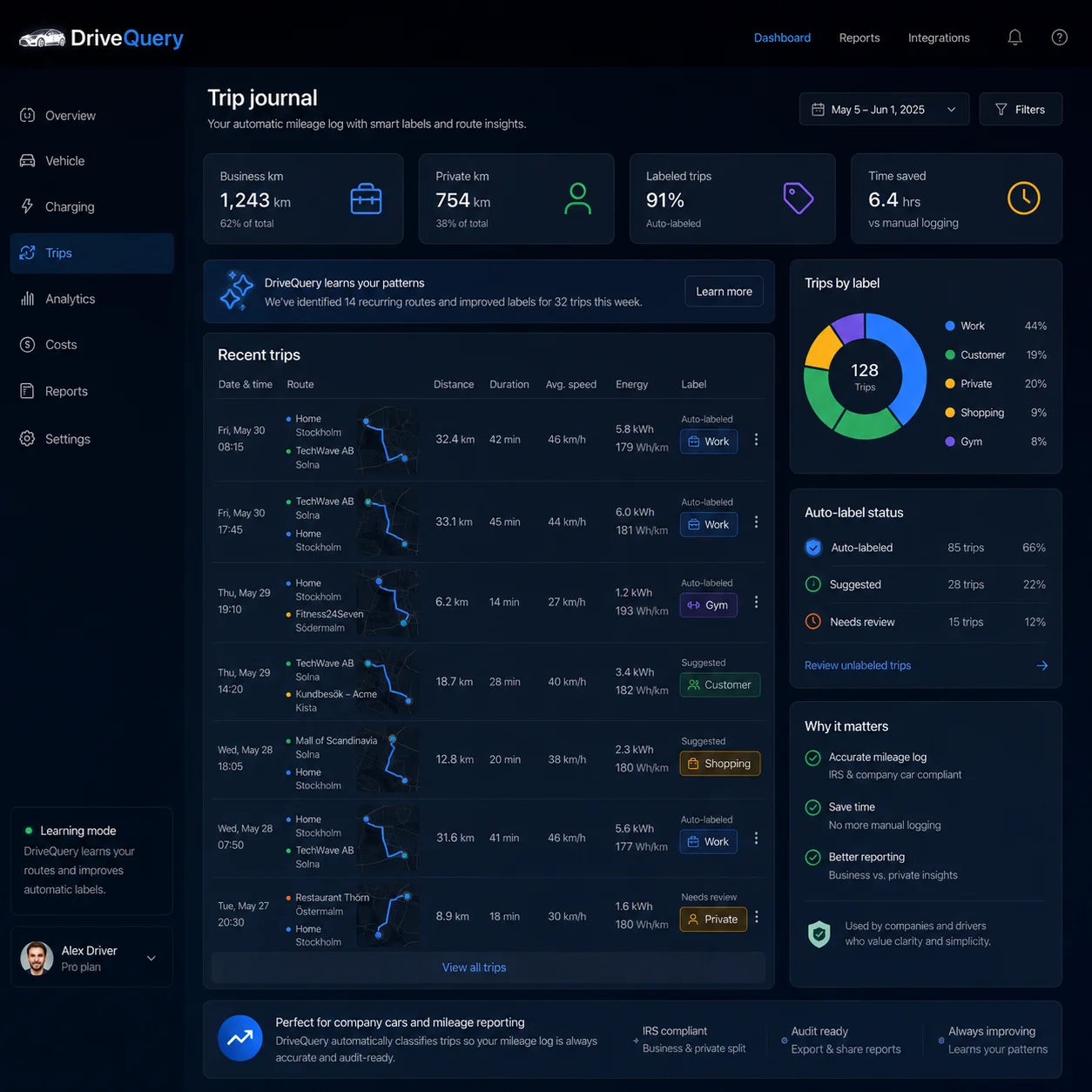
A practical weekly review
- Review newly recorded drives.
- Confirm recurring business and personal places.
- Add a business purpose where context is not already clear.
- Check unusual route splits or missing trips.
- Keep unresolved journeys visible until confirmed.
- Export only after the period has been reviewed.
Example: what a useful mileage-log row looks like
| Date | Destination | Miles | Business purpose | Classification |
|---|---|---|---|---|
| Aug. 24, 2026 | Client A | 31.4 | Quarterly client review | Business |
| Aug. 24, 2026 | Grocery store | 3.2 | — | Personal |
The second trip does not become business mileage simply because it happened between two work-related drives. Each trip needs its own facts and classification.
Three mileage-log mistakes automation should prevent
Rebuilding the year later
Memory gets weaker with time. Timely review creates stronger evidence and fewer unresolved trips.
Calling every workday mile “business”
Ordinary commuting and personal detours are generally different from qualifying business transportation.
Letting the app invent purpose
Pattern recognition can suggest context, but the driver should confirm the real business reason.
Tracking only business miles
Total annual vehicle mileage matters when substantiating completeness and allocating mixed business/personal use.
How long should you keep mileage records?
Publication 463 says records supporting a deduction should be kept as long as they may be needed for administration of the tax law. It gives three years from the filing date as a common rule, while certain vehicle and depreciation records can need to be retained longer. Keep the records required for your specific return and circumstances.
DriveQuery organizes trip evidence; it does not determine tax eligibility. The driver or tax adviser remains responsible for deciding whether a trip qualifies as business transportation and how it should be reported.
Related guides
Official IRS sources
FAQ
IRS mileage log: common questions
What should an IRS mileage log include?
For car transportation, IRS Publication 463 identifies the date of use, business destination, business purpose, mileage for each business use and total miles for the year as key substantiation elements.
Does the IRS accept a digital mileage log?
Yes. IRS Publication 463 says a record prepared on a computer is considered an adequate written record when it otherwise meets the substantiation requirements.
How soon should I record business mileage?
The IRS gives more weight to records made at or near the time of the business use. Publication 463 says a weekly log that accounts for use during the week can be considered timely.
Do I need starting and ending odometer readings for every trip?
Publication 463 focuses on mileage for each business use and total vehicle mileage for the year. Its sample daily log includes odometer readings, but the substantiation table does not state that a start and stop odometer reading is required for every individual trip.
Can a mileage app decide whether a trip is business or personal?
An app can capture trip facts and suggest recurring classifications, but the driver should confirm the actual business purpose and whether a trip qualifies as business transportation.
How long should I keep mileage records?
Publication 463 says records supporting a deduction generally should be kept as long as needed for tax administration and notes three years from filing as a common rule. Some vehicle and depreciation records may need to be kept longer.
Free tool · available now
Create the mileage log in your browser
Enter start and destination addresses, calculate road miles, classify the trip and export PDF or Excel. The 2026 IRS business rate is applied by trip date.
Build the mileage log while the driving is happening.
DriveQuery turns Tesla trip history into a reviewable business-mileage record — with the facts captured automatically and the business purpose left for you to confirm.