
Tesla charging history
Tesla charging history: sessions, energy and cost in one timeline
Tesla already provides charging-history views today. DriveQuery’s combined charging-and-trip timeline is an early-access feature being built to keep individual sessions, places, energy and cost basis together when the required Tesla data is available.
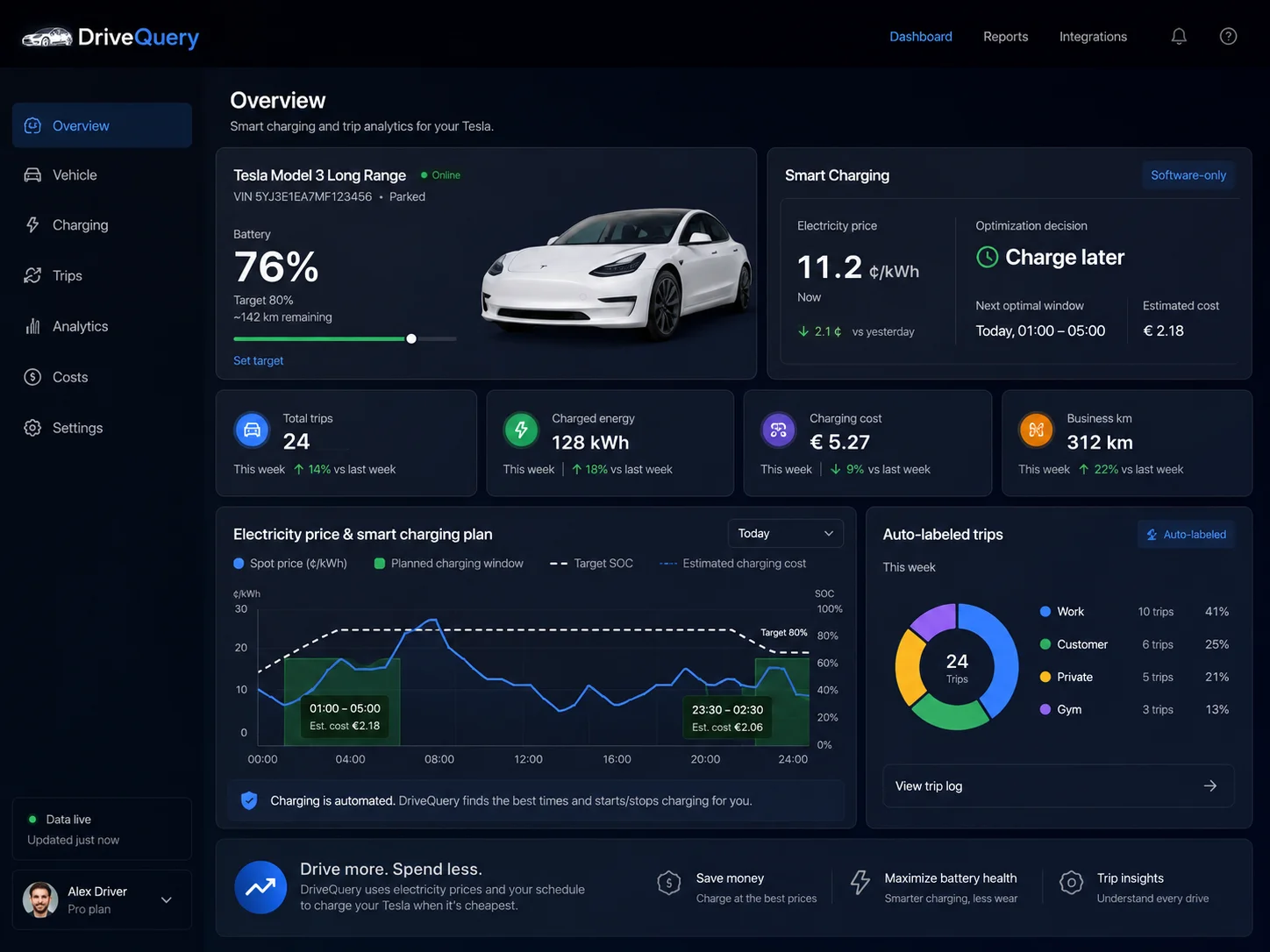
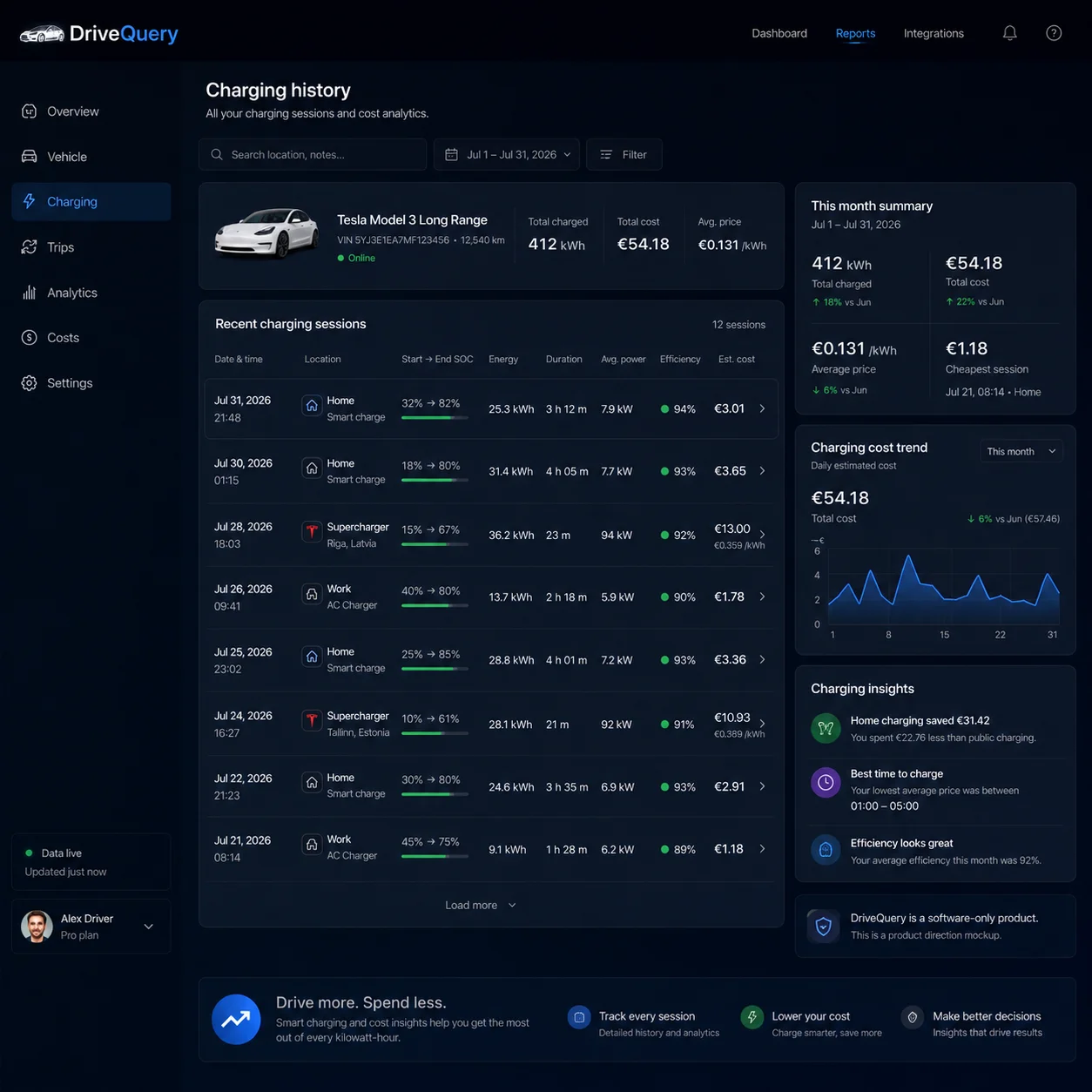
Tesla charging history is useful when it answers more than “how much did I charge?”. A practical record connects individual charging sessions with location, energy, cost context and the driving that followed. DriveQuery is being built around that session-level view.
What Tesla already shows in charging history
Tesla already provides useful charging information in the Tesla app. Vehicle Charge Stats shows charging history over a selected period, including energy charged, estimated spend and a breakdown by charging-location type. A registered Wall Connector can also show a list of charging sessions, while Supercharging history is available separately in the charging area of the app.
| Charging view | Good for | What DriveQuery adds |
|---|---|---|
| Tesla Charge Stats | Energy, estimated spend and location-type trends | Session context linked with trips and user-defined places |
| Wall Connector history | Charger-side sessions, duration and delivered kWh | Vehicle-centred history across more than one charging source |
| Supercharging history | Tesla charging transactions and billed sessions | One timeline alongside home and other charging |
| DriveQuery history | Planned session-level vehicle record | Trips, locations, tariff context, analysis and export in one workflow |
The point is not to replace information Tesla already provides. It is to make charging sessions easier to connect with the rest of the vehicle record.
A readable charging-session timeline
A useful timeline should make it easy to answer when charging started, where it happened, how much energy was involved and how the session relates to recent driving. Available fields depend on the vehicle and charging data made available through the connected Tesla services.
That session view is especially useful when a monthly total looks unusual. Instead of seeing only a number for the month, you can work back through the individual sessions that created it.
Home, public and Supercharger charging tell different stories
Home charging is usually about tariff timing and repeatable overnight behaviour. Public charging may involve several networks and prices. Supercharging has its own transaction history. Treating every kWh as if it came from the same place hides useful information.
- Home: connect session timing with the electricity tariff that applied.
- Public: keep the location and cost basis visible where available.
- Supercharger: keep billed charging distinct from home-cost estimates.
Want to model the price first? Use the Tesla charging cost calculator →
Add electricity-price context without hiding the assumptions
For home charging, energy alone does not tell you the cost. A fixed tariff, time-of-use tariff and dynamic tariff can produce very different results for the same number of kWh. DriveQuery is designed to keep the price basis attached to the session so an estimated cost can be understood later.
See how a Tesla charging schedule can use cheaper periods →
Charging history becomes more useful beside trip history
Charging and driving are two halves of the same running-cost record. When a long journey is followed by a large charging session, the relationship is obvious. Over weeks or months, linking the two makes it easier to understand energy use, cost per mile, charging habits and whether a tariff change is actually helping.
See the Tesla trip history side of the record →
Charging history, cost tracking and export are different jobs
| If you want to… | Best DriveQuery page |
|---|---|
| Review charging sessions and patterns | Tesla charging history — this page |
| Calculate charging prices before or after a session | Tesla charging cost calculator |
| Track cost per individual charging event | Tesla charging cost tracker |
| Move charging data into CSV or PDF | Tesla charging history export |
| Prepare an employer home-charging record | Tesla home charging reimbursement |
Planned DriveQuery charging-history view
- Charging sessions and energy added
- User-defined location labels
- Home, public and Supercharger context
- Time-of-use or dynamic price basis
- Estimated home charging cost
- Charging totals by period
- Links between driving and charging
- Structured export for deeper analysis
Frequently asked questions
Can I see Tesla charging history in the Tesla app?
Yes. Tesla provides several charging-history views. Charge Stats shows vehicle charging trends over a selected period, registered Wall Connectors can show charger session history, and Supercharging history is available in the charging area of the Tesla app.
Does Tesla charging history show cost?
Charge Stats can show estimated charging spend when pricing is configured. Supercharger sessions have transaction pricing. Home charging should be treated as an estimate unless the tariff and measurement basis behind the number are clear.
What is the difference between charging history and a charging-history export?
Charging history is designed to review sessions and patterns on screen. An export turns that record into reusable data such as CSV or a shareable report such as PDF.
Can charging history be linked with Tesla trip history?
That is a core DriveQuery design goal: keep charging sessions and driving records close enough that energy, distance, locations and costs can be analysed together.
Official Tesla sources
- Tesla UK: Understanding Charge Stats
- Tesla UK: Wall Connector charging history
- Tesla UK: Supercharging history and pricing
Need the data outside the app? See Tesla charging history export →
A clearer record of every drive.
Join the waitlist and help shape the first version.